MCQ
Two simple harmonic motions of angular frequency $100$ and $1000\,\,rad\,s^{-1}$ have the same displacement amplitude. The ratio of their maximum acceleration is
  • A
    $1:10^3$
  • B
    $1:10^4$
  • C
    $1:10$
  • $1:10^2$

Answer

Correct option: D.
$1:10^2$
d
$\omega_{1}=100 \mathrm{rad} \mathrm{s}^{-1} ; \omega_{2}=1000 \mathrm{rad} \mathrm{s}^{-1}$

Maximum acceleration of $(1)=-\omega_{1}^{2} A$

Maximum acceleration of $(2)=-\omega_{2}^{2} A$

$\therefore \frac{\operatorname{accln}(1)}{\operatorname{accln}(2)}=\frac{\omega_{1}^{2}}{\omega_{2}^{2}}=\frac{(100)^{2}}{(1000)^{2}}=\frac{1}{100}$

$a(1): a(2)=1: 100$.

Need a full question paper?

Generate a complete, print-ready paper with questions like this in minutes — across 16+ boards, with answer keys.

Start Generating Free

Similar questions

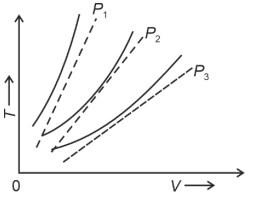
The following graph represents the $T-V$ curves of an ideal gas (where $T$ is the temperature and $V$ the volume) at three pressures $P_1, P_2$ and $P_3$ compared with those of Charles's law represented as dotted lines.

Then the correct relation is:

Time period of pendulum, on a satellite orbiting the earth, is
A particle is moving in a circular path of radius $r$ under the action of a force $F$. If at an instant velocity of particle is $v$, and speed of particle is increasing, then
A capacitor of capacitance $500\mu\text{F}$ is connected to a battery through a $10\text{k}\Omega$ resistor. The charge stored in the capacitor in the first 5s is larger than the charge stored in the next:
  1. 5s
  2. 50s
  3. 500s
  4. 500
If pressure of a gas contained in a closed vessel is increased by $0.4\%$ when heated by $1°C,$ the initial temperature must be
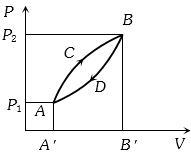
A thermodynamic system is taken from state $A$ to $B$ along $ACB$ and is brought back to $A$ along $BDA$ as shown in the $PV$ diagram. The net work done during the complete cycle is given by the area
A body starts from rest from the origin with an acceleration of $6 \;m / s^2$ along the $x$-axis and $8\; m / s^2$ along the $y$-axis. Its distance from the origin after $4\; seconds$ will be
The time period of a particle in simple harmonic motion is equal to the smallest time between the particle acquiring a particular velocity $\overrightarrow{\text{v}}.$ The value of v is
  1. vmax.
  2. 0
  3. between 0 and vmax.
  4. between 0 and - vmax
A rope is wound round a hollow cylinder of mass $5\,kg$ and radius $0.5\,m.$ ........ $rad/s^2$ is the angular acceleration of the cylinder if the rope is pulled with a force of $20\,N$ ?
A particle moves in the $x-y$ plane under the action of a force $\,\vec F$ such that the value of its linear momentum $(\,\vec P)$ at anytime $t$ is $P_x = 2cost$ , $P_y = 2sint$ . The angle between $\,\vec F$ and $\,\vec P$ at a given time $t$ , will be