MCQ
Two simple pendulums whose lengths are $100 \ cm$ and $121 \ cm$ are suspended side by side. Their bobs are pulled together and then released. After how many minimum oscillations of the longer pendulum, will the two be in phase again
  • A
    $11$
  • $10$
  • C
    $21$
  • D
    $20$

Answer

Correct option: B.
$10$
Let $T_1$ and $T_2$ are the time period of the two pendulums $T_1=2 \pi \sqrt{\frac{100}{g}} \text { and } T_2=2 \pi \sqrt{\frac{121}{g}}\ (T_1)=  10$

Need a full question paper?

Generate a complete, print-ready paper with questions like this in minutes — across 16+ boards, with answer keys.

Start Generating Free

Similar questions

A small piece of wire bent into an $L$ shape with upright and horizontal portions of equal lengths, is placed with the horizontal portion along the axis of the concave mirror whose radius of curvature is $10 \mathrm{~cm}$. If the bend is $20 \mathrm{~cm}$ from the pole of the mirror, then the ratio of the lengths of the images of the upright and horizontal portions of the wire is
The material of permanent magnet has
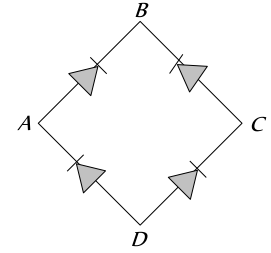
In the diagram, the input is across the terminals $A$ and $C$ and the output is across the terminals $B$ and $D$, then the output is
Image
Which of the following velocity-time graphs represent uniform motion
Rate of change of torque $\tau$ with deflection $\theta$ is maximum for a magnet suspended freely in a uniform magnetic field of induction $B$, when
A coil and a bulb are connected in series with a dc source, a soft iron core is then inserted in the coil. Then
In a transformer, number of turns in the primary are $140$ and that in the secondary are $280.$ If current in primary is $4\ A$ then that in the secondary is
The temperature of a body falls from $50^{\circ} \mathrm{C}$ to $40^{\circ} \mathrm{C}$ in 10 minutes. If the temperature of the surroundings is $20^{\circ} \mathrm{C}$ Then temperature of the body after another 10 minutes will be
Milky way is
A $5 m$ long aluminium wire $\left(Y=7 \times 10^{10} N / m ^2\right)$ of diameter $3 mm$ supports a $40 kg$ mass. In order to have the same elongation in a copper wire ( $\left.Y=12 \times 10^{10} N / m ^2\right)$ of the same length under the same weight, the diameter should now be, in $mm$.