MCQ
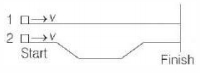
Two small blocks slide without losing contact with the surface along two frictionless tracks $1$ and $2$ , starting at the same time with same initial speed $v$. Track $1$ is perfectly horizontal, while track $2$ has a dip in the middle, as shown in the figure.Which block reaches the finish line first?[Hint: Use velocity-time graph to solve]
  • A
    Block on track $1$ reaches the finish line first
  • Block on track $2$ reaches the finish line first
  • C
    Both blocks reach the finish line at the same time
  • D
    It depends on the length of the dip in the second track. relative to the total length of the tracks
Answer

Correct option: B.
Block on track $2$ reaches the finish line first
b
(b)

Block $2$ moves for a certain period of time with higher velocity (compared to that of block $1$).

So, block $2$ finishes the race earlier.

Need a full question paper?

Generate a complete, print-ready paper with questions like this in minutes — across 16+ boards, with answer keys.

Start Generating Free

Similar questions

A thin uniform cylindrical shell, closed at both ends, is partially filled with water. It is floating vertically in water in half-submerged state. If $\rho_0$ is the relative density of the material of the shell with respect to water, then the correct statement is that the shell is
How much work to be done in decreasing the volume of and ideal gas by an amount of $2.4 \times {10^{ - 4}}{m^3}$ at normal temperature and constant normal pressure of .......$joule$  $1 \times {10^5}N/{m^2}$
A projectile is thrown into space so as to have a maximum possible horizontal range of $400$ metres. Taking the point of projection as the origin, the co-ordinates of the point where the velocity of the projectile is minimum are
Two metal spheres of capacitances C1 and C2 carry some charges. They are put in contact and then separated. The final charges Q1 and Q2 on them will satisfy:

  1. $\frac{\text{Q}_1}{\text{Q}_2}<\frac{\text{C}_1}{\text{C}_2}$

  2. $\frac{\text{Q}_1}{\text{Q}_2}=\frac{\text{C}_1}{\text{C}_2}$

  3. $\frac{\text{Q}_1}{\text{Q}_2}>\frac{\text{C}_1}{\text{C}_2}$

  4. $\frac{\text{Q}_1}{\text{Q}_2}=\frac{\text{C}_2}{\text{C}_1}$

Equation of a progressive wave is given by $y = a\,\sin \pi \,\left[ {\frac{t}{2} - \frac{x}{4}} \right]\,,$ where $t$ is in seconds and $x$ is in meters. The distance through which the wave moves in $8 sec$ is .... $(m)$ (in meter)
A wind with speed $40\,\, m/s$ blows parallel to the roof of a house. The area of the roof is $250\, m^2.$ Assuming that the pressure inside the house is atmospheric pressure, the force exerted by the wind on the roof and the direction of the force will be  $(\rho _{air} = 1.2  \,\,kg/m^3)$ 
A man (mass $= 50\, kg$) and his son (mass $= 20\, kg$) are standing on a frictionless surface facing each other. The man pushes his son so that he starts moving at a speed of $0.70\, ms^{-1}$ with respect to the man. The speed of the man with respect to the surface is ........ $ms^{-1}$
An object is placed in a medium of refractive index $3$. An electromagnetic wave of intensity $6 \times 10^8 \mathrm{~W} / \mathrm{m}^2$ falls normally on the object and it is absorbed completely. The radiation pressure on the object would be (speed of light in free space $=3 \times 10^8 \mathrm{~m} / \mathrm{s}$ ):
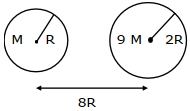
Suppose two planets (spherical in shape) of radii ${R}$ and $2 {R}$, but mass ${M}$ and $9\, {M}$ respectively have a centre to centre separation $8\, {R}$ as shown in the figure. A satellite of mass $'{m}'$ is projected from the surface of the planet of mass $'M'$ directly towards the centre of the second planet. The minimum speed $'v'$ required for the satellite to reach the surface of the second planets is $\sqrt{\frac{a}{7} \frac{G M}{R}}$ then the value of $'a'$ is $....$

[Given: The two planets are fixed in their position]

The elastic limit of brass is $379\,MPa.$ .......... $mm$ should be the minimum diameter of a brass rod if it is to support a $400\,N$ load without exceeding its elastic limit .