Question
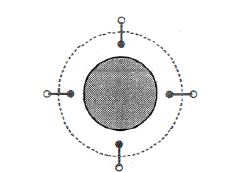
Two small, equal masses are attached by a light weight rod. This object orbits a planet ; the length of the rod is smaller than the radius of the orbit, but not negligible. The rod rotates about its axis in such a way that it remains vertical with respect to the planet. (Assume in each case perturbation maintains the rate of rotation, so that in the co-rotating frame the rod is  still stationary but at an angle to the vertical.)
Answer

Get the step-by-step solution for this question inside the Vidyadip app.

Get the answer in the app

Need a full question paper?

Generate a complete, print-ready paper with questions like this in minutes — across 16+ boards, with answer keys.

Start Generating Free

Similar questions

Acetaldehyde and Acetone can be distinguished by
Two condensers of capacities $2C$ and $C$ are joined in parallel and charged upto potential $V$. The battery is removed and the condenser of capacity $C$ is filled completely with a medium of dielectric constant $K$. The $p.d.$ across the capacitors will now be
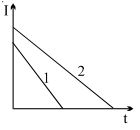
Two identical inductance carry currents that vary with time according to linear laws (as shown in figure). In which of two inductance is the self induction $emf$ greater?
An object of mass $0.2\  kg$ executes simple harmonic along $X-$ axis with frequency of $\frac{{25}}{\pi } Hz$ . At the position $x$ =  $0.04\ m$ , the object has kinetic energy of $0.5\  J$ and potential energy of $0.4\  J$ amplitude of oscillation in meter is equal to
A smooth sphere $A$ is moving on a frictionless horizontal plane with angular speed $\omega $ and center of mass with velocity $v$. It collides elastically and head-on with an identical sphere $B$ at rest. Neglect friction everywhere. After the collision, their angular speeds are ${\omega _A}$ and ${\omega _B}$ respectively. Then
In $C.G.S$. system the magnitutde of the force is $100$ dynes. In another system where the fundamental physical quantities are kilogram, metre and minute, the magnitude of the force is
Kerosene oil rises up the wick in a lantern
The length $l$, breadth b and thickness t of a block of wood were measured with the help of a measuring scale. The results with permissible errors are $l=15.12 \pm 0.01\; cm , t =5.28 \pm 0.01 \;cm$ $b =10.15 \pm 0.01\; cm$. The percentage error in volume upto proper significant figures is
A convex lens makes a real image $4 cm$ long on a screen. When the lens is shifted to a new position without disturbing the object, we again get a real image on the screen which is $16 cm$ tall. The length of the object must be.......$cm$
A screw gauge has $50$ divisions on its circular scale. The circular scale is $4$ units ahead of the pitch scale marking, prior to use. Upon one complete rotation of the circular scale, a displacement of $0.5\, mm$ is noticed on the pitch scale. The nature of zero error involved, and the least count of the screw gauge, are respectively