MCQ
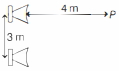
Two small identical speakers are connected in phase to the same source. The speakers are $3 \,m$ apart and at ear level. An observer stands at $P, 4 \,m$ in front of one speaker as shown alongside. The sound she hears is least intense when the wavelength is $\lambda_1$ and most intense when the wavelength is $\lambda_2$. Then, the possible values of $\lambda_1$ and $\lambda_2$ are
  • A
    $\lambda_1=1 \,m$ and $\lambda_2=2 \,m$
  • B
    $\lambda_1=4 \,m$ and $\lambda_2=3 \,m$
  • $\lambda_1=2 \,m$ and $\lambda_2=1 \,m$
  • D
    $\lambda_1=0.5 \,m$ and $\lambda_2=025 \,m$
Answer

Correct option: C.
$\lambda_1=2 \,m$ and $\lambda_2=1 \,m$
c
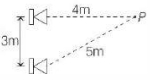
(c) Path difference of sounds from speakers $A$ and $B$ is $1 \,m (=5 \,m -4 \,m )$.

For least intense sound, $1 \,m$ can cause a destructive interference. So, path difference is an odd multiple of half wavelength.

$\Rightarrow \Delta L=(2 n+1) \frac{\lambda_1}{2}$

$\Rightarrow 1 \,m =\frac{\lambda_1, 3 \lambda_1, 5 \lambda_1}{2}, \frac{2}{2}, \text { etc. }$

Above condition is satisfied, when $\lambda_1=2 \,m$.

And for most intense sound, path difference of $1 m$ can cause a constructive interference. So, path difference must be a whole number multiple of one wavelength.

$\Rightarrow \Delta L=n \lambda_2$

$\Rightarrow 1 \,m =\lambda_2, 2 \lambda_2, 3 \lambda_2, \ldots, \text { etc. }$

Above condition is satisf ied with $\lambda_2=1 \,m$.

So, correct option is $(c)$.

Need a full question paper?

Generate a complete, print-ready paper with questions like this in minutes — across 16+ boards, with answer keys.

Start Generating Free

Similar questions

The work done in pulling up a block of wood weighing $2 \,kN$ for a length of 10m on a smooth plane inclined at an angle of $15°$ with the horizontal is ............. $\mathrm{kJ}$
Both earth and moon are subject to the gravitational force of the sun. As observed from the sun, the orbit of the moon.
What is the ratio of densities of 2 gases, O2 & N2, having partial pressures in the ratio 2:3?
The force constants of two springs are ${K_1}$ and ${K_2}$. Both are stretched till their elastic energies are equal. If the stretching forces are ${F_1}$ and ${F_2}$, then ${F_1}:{F_2}$ is
If a particle moves in a circle describing equal angles in equal times, its velocity vector
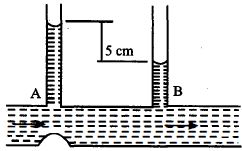
In the diagram shown, the difference in the two tubes of the manometer is $5\, cm$, the cross section of the tube at $A$ and $B$ is $6\, mm^2$ and $10\, mm^2$ respectively. The rate at which water flows through the tube is ........ $ cc/s$ $(g\, = 10\, ms^{-2})$
A satellite is moving in a low nearly circular orbit around the earth. Its radius is roughly equal to that of the earth's radius $R _{ e }$. By firing rockets attached to it, its speed is instantaneously increased in the direction of its motion so that is become $\sqrt{\frac{3}{2}}$ times larger. Due to this the farthest distance from the centre of the earth that the satellite reaches is $R$, value of $R$ is$....R_e$
A mass $m$ is placed at point $P$ lies on the axis of a ring of mass $M$ and radius $R$ at a distance $R$ from its centre. The gravitational force on mass $m$ is
$Assertion$ : Specific gravity of a fluid is a dimensionless quantity.

$Reason$ : It is the ratio of density of fluid to the density of water

An object is thrown along a direction inclined at an angle of ${45^o}$ with the horizontal direction. The horizontal range of the particle is equal to