MCQ
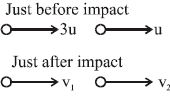
Two smooth objects with a coefficient of restitution $e,$ collide directly and bounce as shown. Newton's law of restitution gives
  • A
    $e \times 4u = v_2 + v_1$
  • B
    $e \times 2u = v_1 + v_2$
  • $e \times 2u = v_2 - v_1$
  • D
    it cannot be applied as the masses are not known
Answer

Correct option: C.
$e \times 2u = v_2 - v_1$
c
$H=20+15=35 \mathrm{m}$

${\mathrm{e}=\frac{\mathrm{v}_{2}-\mathrm{v}_{1}}{\mathrm{u}_{1}-\mathrm{u}_{2}}}$

${\mathrm{e}=\frac{\mathrm{v}_{2}-\mathrm{v}_{1}}{3 \mathrm{u}-\mathrm{u}_{1}}}$

${\mathrm{e}(2 \mathrm{u})=\mathrm{v}_{2}-\mathrm{v}_{1}}$

Need a full question paper?

Generate a complete, print-ready paper with questions like this in minutes — across 16+ boards, with answer keys.

Start Generating Free

Similar questions

Hairs of shaving brush cling together when it is removed from water due to
A tank is filled upto a height $h$ with a liquid and is placed on a platform of height h from the ground. To get maximum range ${x_m}$ a small hole is punched at a distance of $y$ from the free surface of the liquid. Then
A particle is moving on a circular path of radius $r$ with uniform velocity $v$. The change in velocity when the particle moves from $P$ to $Q$ is $(\angle POQ = 40^\circ )$
A tuning fork of frequency $100$ when sounded together with another tuning fork of unknown frequency produces $2$ beats per second. On loading the tuning fork whose frequency is not known and sounded together with a tuning fork of frequency $100$ produces one beat, then the frequency of the other tuning fork is
Which of the following is the correct device for the detection of thermal radiation
The rate of recombination or generation are governed by the law(s) of
Which of the following formulae is wrong
Two identical coherent sound sources $R$ and $S$ with frequency $f$ are $5 \,m$ apart. An observer standing equidistant from the source and at a perpendicular distance of $12 \,m$ from the line $R S$ hears maximum sound intensity.When he moves parallel to $R S$, the sound intensity varies and is a minimum when he comes directly in front of one of the two sources. Then, a possible value of $f$ is close to ............ $Hz$ (the speed of sound is $330 \,m / s$ )
The maximum speed that can be achieved without skidding by a car on a circular unbanked road of radius $R$ and coefficient of static friction $\mu $, is
As observed from earth, the sun appears to move in an approximate circular orbit. For the motion of another planet like mercury as observed from earth, this would.