$R=\frac{\rho l}{A}$
$\therefore \quad A=\frac{\rho l}{R}$
$\Rightarrow \frac{A_{1}}{A_{2}}=\frac{\rho_{1}}{\rho_{2}} \times \frac{L_{1}}{I_{2}}\left(\frac{R_{2}}{R_{1}}\right)$
$\Rightarrow \frac{A_{1}}{A_{2}}=1 \quad\left[\because R_{1}=R_{2}, I_{1}=l_{2}\right.$ and for same
material $\left.\rho_{1}=\rho_{2}\right]$
Generate a complete, print-ready paper with questions like this in minutes — across 16+ boards, with answer keys.
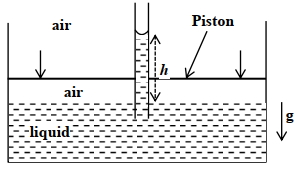
[Given: Surface tension of the liquid is $0.075 \mathrm{Nm}^{-1}$, atmospheric pressure is $10^5 \mathrm{~N} \mathrm{~m}^{-2}$, acceleration due to gravity $(g)$ is $10 \mathrm{~m} \mathrm{~s}^{-2}$, density of the liquid is $10^3 \mathrm{~kg} \mathrm{~m}^{-3}$ and contact angle of capillary surface with the liquid is zero]