MCQ
Two solid spheres of different mass, radii and density roll down a rough inclined plane under identical situation. Their time to come down is independent of their ............
  • A
    Mass
  • B
    Radius
  • C
    Density
  • All of these

Answer

Correct option: D.
All of these
d
(d)

For rolling down an inclined plane,

$a_{c m}=\frac{g \sin \theta}{1+\frac{1}{m R^2}}$

For 5 phere of mass $m$ and radius $R, 1=\frac{2}{5} m R^2$

So, $\quad a_{c u}=\frac{g \sin 0}{1-\frac{2}{5}\left({m R^2}^2\right)}=\frac{5}{7} g \sin 0$

As acceleration of centre of mass of rolling body only depends upon angle of inclination,

So, time taken to come down, $t =\sqrt{\frac{2 L}{a_{c h}}}$

$\left(\because L=\frac{1}{2} a_{c n} t^2\right)$

$t=\sqrt{\frac{2 L \times 7}{5 g \sin \theta}}=\sqrt{\frac{14 L}{5 g \sin \theta}}$, where $L=$ length of inclined plane.

Here, $t$ is independent of mass, radius and density of spheres. Option (d) is correct.

Need a full question paper?

Generate a complete, print-ready paper with questions like this in minutes — across 16+ boards, with answer keys.
Start Generating Free

Similar questions

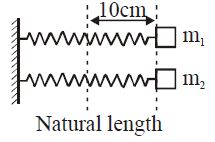
The drawing shows a top view of a frictionless horizontal surface, where there are two indentical springs with particles of mass $m_1$ and $m_2$ attached to them. Each spring has a spring constant of $1200\  N/m.$ The particles are pulled to the right and then released from the  positions shown in the drawing. How much time passes before the particles are again side by side for the first time if $m_1 = 3.0\  kg$ and $m_2 = 27 \,kg \,?$
Two gases occupy two containers $A$ and $B$ the gas in $A$, of volume $0.10\,m ^3$, exerts a pressure of $1.40\,MPa$ and that in $B$ of volume $0.15 m ^3$ exerts a pressure $0.7\,MPa$. The two containers are united by a tube of negligible volume and the gases are allowed to intermingle. Then if the temperature remains constant, the final pressure in the container will be (in MPa)
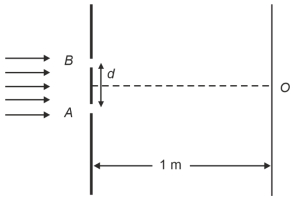
In a Young's double slit experiment, each of the two slits $A$ and $B$, as shown in the figure, are oscillating about their fixed center and with a mean separation of $0.8 mm$. The distance between the slits at time $t$ is given by $d=(0.8+0.04 \sin \omega t) mm$, where $\omega=0.08 rad s ^{-1}$. The distance of the screen from the slits is $1 m$ and the wavelength of the light used to illuminate the slits is $6000 \mathring A$. The interference pattern on the screen changes with time, while the central bright fringe (zeroth fringe) remains fixed at point $O$.

($1$) The $8^{\text {mh }}$ bright fringe above the point $O$ oscillates with time between two extreme positions. The separation between these two extreme positions, in micrometer $(\mu m )$, is. . . . .

($2$) The maximum speed in $\mu m / s$ at which the $8^{\text {th }}$ bright fringe will move is. . . . .

Give the answer or quetion ($1$) and ($2$)
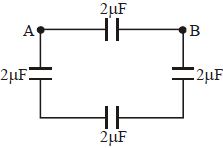
The equivalent capacitance between the points $A$ and $B$ in the given diagram is
A rocket has an initial mass of $20 \times {10^3}\,kg$. If it is to blast off with an initial acceleration of $4\,m{s^{ - 2}}$, the initial thrust needed is  $(g = 10\,m{s^{ - 2}})$
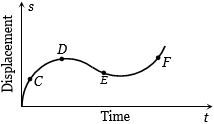
The displacement-time graph of moving particle is shown below. The instantaneous velocity of the particle is negative at the point
Two cars are moving in the same direction with a speed of $30 \,km / h$. They are separated from each other by $5 \,km$. Third car moving in the opposite direction meets the two cars after an interval of $4$ minutes. The speed of the third car is .......... $km / h$
If yellow light in the Young's double slit experiment is replaced by red light, the fringe width will
The position vector $\vec{r}$ of a particle of mass $m$ is given by the following equation

$\vec{r}(t)=\alpha t^3 \hat{i}+\beta t^2 \hat{j}$

where $\alpha=10 / 3 \mathrm{~m} \mathrm{~s}^{-3}, \beta=5 \mathrm{~m} \mathrm{~s}^{-2}$ and $m=0.1 \mathrm{~kg}$. At $t=1 \mathrm{~s}$, which of the following statement($s$) is(are) true about the particle?

($A$) The velocity $\vec{v}$ is given by $\vec{v}=(10 \hat{i}+10 \hat{j}) \mathrm{ms}^{-1}$

($B$) The angular momentum $\vec{L}$ with respect to the origin is given by $\vec{L}=-15 / 3) \hat{k} \mathrm{~N} \mathrm{~m} \mathrm{~s}$

($C$) The force $\vec{F}$ is given by $\vec{F}=(\hat{i}+2 \hat{j}) \mathrm{N}$

($D$) The torque $\vec{\tau}$ with respect to the origin is given by $\vec{\tau}=-(20 / 3) \hat{k} \mathrm{~N} \mathrm{~m}$
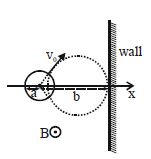
An electron is projected normally from the surface of a sphere with speed $v_0$ in a uniform magnetic field perpendicular to the plane of the paper such that its strikes symmetrically opposite on the sphere with respect to the $x-$ axis. Radius of the sphere is $'a'$ and the distance of its centre from the wall is $'b'$ . What should be magnetic field such that the charge particle just escapes the wall