Two sound waves of intensity $2 \,W / m ^2$ and $3 \,W / m ^2$ meet at a point to produce a resultant intensity $5 \,W / m ^2$. The phase difference between two waves is ......
Easy
Download our app for free and get started
(c)
$I=I_1+I_2+2 \sqrt{T_1} \sqrt{T_2} \cos \phi$
$5=3+2+2 \sqrt{6} \cos \phi$
$\therefore \cos \phi=0$
$\text { or } \phi=\frac{\pi}{2}$

Download our appand get started for free
Experience the future of education. Simply download our apps or reach out to us for more information. Let's shape the future of learning together!No signup needed.*
Similar Questions
- 1A whistle of frequency $500 Hz$ tied to the end of a string of length $1.2 m$ revolves at $400 \,rev/min$. A listener standing some distance away in the plane of rotation of whistle hears frequencies in the range (speed of sound $= 340 m/s$)View Solution
- 2A transverse wave travels along $x$-axis. The particles of medium moveView Solution
- 3View SolutionA string fixed at both ends resonates at a certain fundamental frequency. Which of the following adjustments would not affect the fundamental frequency?
- 4The displacement of the interfering light waves are ${y_1} = 4\sin \omega \,t$ and ${y_2} = 3\sin \left( {\omega \,t + \frac{\pi }{2}} \right)$. What is the amplitude of the resultant waveView Solution
- 5A guitar string of length $90\,cm$ vibrates with a fundamental frequency of $120\,Hz.$ The length of the string producing a fundamental frequency of $180\,Hz$ will be $...........cm$.View Solution
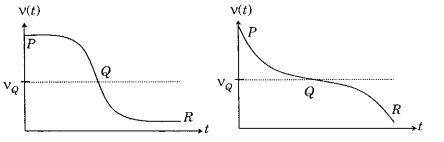
- 6Two loudspeakers $M$ and $N$ are located $20 \mathrm{~m}$ apart and emit sound at frequencies $118 \mathrm{~Hz}$ and $121 \mathrm{~Hz}$, respectively. $A$ car is initially at a point $P, 1800 \mathrm{~m}$ away from the midpoint $Q$ of the line $M N$ and moves towards $Q$ constantly at $60 \mathrm{~km} / \mathrm{hr}$ along the perpendicular bisector of $M N$. It crosses $Q$ and eventually reaches a point $R, 1800(m$ away from $Q$. Let $v(t)$ represent the beat frequency measured by a person sitting in tlie car at time $t$. Let $v_P, v_Q$ and $v_R$ be the beat frequencies measured at locations $P . Q$ and $R$, respectively. The speed of sound in air is $330 \mathrm{~m} \mathrm{~s}^{-1}$. Which of the following statement($s$) is(are) true regarding the sound heard by the person?View Solution
($A$) $v_P+v_R=2 v_Q$
($B$) The rate of change in beat frequency is maximum when the car passes through $Q$
($C$) The plot below represents schematically the variation of beat frequency with time
(image)
($D$) The plot below represents schematically the variation of beat frequency with time
(image)
- 7Two identical wires have the same fundamental frequency of $400 Hz$. when kept under the same tension. If the tension in one wire is increased by $2\%$ the number of beats produced will beView Solution
- 8When a source of sound crosses a stationary observer then the change in apparent frequency of sound observed by the observer, when $V_{ s } < < V$, will be -View Solution
- 9A source of sound is travelling with a velocity $40\, km/hour$ towards observer and emits sound of frequency $2000 Hz$. If velocity of sound is $1220 \,km/hour$, then what is the apparent frequency heard by an observer .... $Hz$View Solution
- 10A closed organ pipe and an open pipe of same length produce $4$ beats when they are set into vibrations simultaneously. If the length of each of them were twice their initial lengths, the number of beats produced will beView Solution