Two sources of sound $A$ and $B$ produces the wave of $350 Hz$, they vibrate in the same phase. The particle $P$ is vibrating under the influence of these two waves, if the amplitudes at the point $P$ produced by the two waves is $0.3 mm$ and $0.4 mm,$ then the resultant amplitude of the point $P$ will be when $AP -BP = 25 cm$ and the velocity of sound is $350 m/sec$ .... $mm$
Diffcult
Download our app for free and get started
(d) $\lambda = \frac{v}{n} = \frac{{350}}{{350}} = 1\,m=100 cm$
Also path difference $(\Delta x)$ between the waves at the point of observation is $AP - BP = 25cm$.
Hence
==> $\Delta \phi = \frac{{2\pi }}{\lambda }(\Delta x) = \frac{{2\pi }}{1} \times \left( {\frac{{25}}{{100}}} \right) = \frac{\pi }{2}$
==> $ A = \sqrt {{{({a_1})}^2} + {{({a_2})}^2}} = \sqrt {{{(0.3)}^2} + {{(0.4)}^2}} = 0.5 mm$

Download our appand get started for free
Experience the future of education. Simply download our apps or reach out to us for more information. Let's shape the future of learning together!No signup needed.*
Similar Questions
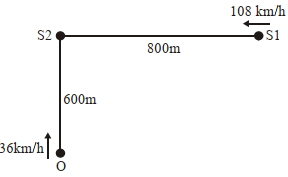
- 1A train $S1$, moving with a uniform velocity of $108 km / h$, approaches another train $S 2$ standing on a platform. An observer $O$ moves with a uniform velocity of $36 km / h$ towards $S 2$, as shown in figure. Both the trains are blowing whistles of same frequency $120 Hz$. When $O$ is $600 m$ away from $S 2$ and distance between $S 1$ and $S 2$ is $800 m$, the number of beats heard by $O$ is. . . . . [Speed of the sound $=330 m / s$ ]View Solution
- 2If two waves represented by $y_1 = 4\, \sin\, \omega t$ and ${y_2} = 3\sin \,\left( {\omega t + \frac{\pi }{3}} \right)$ interfere at a point, then amplitude of the resulting wave will be aboutView Solution
- 3A transverse wave is described by the equation $y = A \,\,sin\,[2\pi (f t - x/\lambda ) ]$.The maximum particle velocity is equal to four times the wave velocity if:View Solution
- 4The wave equation is $y = 0.30\sin (314t - 1.57x)$ where $t, x$ and $y$ are in second, meter and centimeter respectively. The speed of the wave is ..... $m/s$View Solution
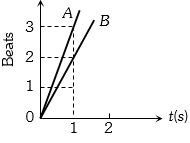
- 5Two tuning forks $P$ and $Q$ are vibrated together. The number of beats produced are represented by the straight line $OA$ in the following graph. After loading $Q$ with wax again these are vibrated together and the beats produced are represented by the line $OB.$ If the frequency of $P$ is $341Hz,$ the frequency of $Q$ will be ... $ Hz$View Solution
- 6In an experiment to measure the speed of sound by a resonating air column, a tuning fork of frequency $500 Hz$ is used. The length of the air column is varied by changing the level of water in the resonance tube. Two successive resonances are heard at air columns of length $50.7 cm$ and $83.9 cm$. Which of the following statements is (are) true?View Solution
$(A)$ The speed of sound determined from this experiment is $332 m s ^{-1}$
$(B)$ The end correction in this experiment is $0.9 cm$
$(C)$ The wavelength of the sound wave is $66.4 cm$
$(D)$ The resonance at $50.7 cm$ corresponds to the fundamental harmonic
- 7If two tuning forks $A$ and $B$ are sounded together, they produce $4$ beats per second. $A$ is then slightly loaded with wax, they produce $2$ beats when sounded again. The frequency of $A$ is $256.$ The frequency of $B$ will beView Solution
- 8$Assertion :$ Sound waves cannot travel in vacuum but light can travel in vacuum.View Solution
$Reason :$ Sound waves are longitudinal waves and they cannot be polarised but electromagentic waves are transverse and they can be polarised. - 9A sonometer wire resonates with a given tuning fork forming standing waves with five antinodes between the two bridges when a mass of $9 kg$ is suspended from the wire. When this mass is replaced by a mass $M$, the wire resonates with the same tuning fork forming three antinodes for the same positions of the bridges. The value of $M$ is ... $kg$View Solution
- 10A tuning fork and an air column whose temperature is $51^{\circ} C$ produce $4$ beats in one second, when sounded together. When the temperature of air column decreases the number of beats per second decreases. When the temperature remains $16^{\circ} C$ only one beat per second is produced. The frequency of the tuning fork is ........... $Hz$View Solution