MCQ
Two sources of sound $S_1$ and $S_2$ produce sound waves of same frequency $660\, Hz$. A listener is moving from source $S_1$ towards $S_2$ with a constant speed $u\, m/s$ and he hears $10\, beats/s$. The velocity of sound is $330\, m/s$. Then, $u$ equals ... $m/s$
  • A
    $15.0$
  • B
    $10.0$
  • C
    $5.5$
  • $2.5$

Answer

Correct option: D.
$2.5$
d
$f=660\,Hz,$     $v=330\,m/s$

$f_{1}=f\left(\frac{v-u}{v}\right) ; \quad f_{2}=f\left(\frac{v+u}{v}\right)$

$\mathrm{f}_{2}-\mathrm{f}_{1}=\frac{\mathrm{f}}{\mathrm{v}}[\mathrm{v}+\mathrm{u}-(\mathrm{v}-\mathrm{u})]$

$10=\mathrm{f}_{2}-\mathrm{f}_{1}=\frac{\mathrm{f}}{\mathrm{v}}[2 \mathrm{u}]$

$u=2.5 \mathrm{m} / \mathrm{s}$

Need a full question paper?

Generate a complete, print-ready paper with questions like this in minutes — across 16+ boards, with answer keys.

Start Generating Free

Similar questions

Two cars OF SAME LENGTH move in the same direction along parallel roads. One of them is a $100\ m$ long travelling with a velocity of $7.5\  ms^{−1}.$ How long will it take for the first car to overtake the second car?
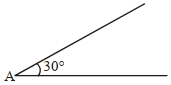
A sphere of mass $2\,kg$ and radius $0.5\, m$ is rolling with an initial speed of $1 \,ms ^{-1}$ goes up an inclined plane which makes an angle of $30^{\circ}$ with the horizontal plane, without slipping. How low will the sphere take to return to the starting point $A$ ? (in $second$)
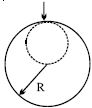
A spherical hole of radius $R/2$ is excavated from the asteroid of mass $M$ as shown in fig. The gravitational acceleration at a point on the surface of the asteroid just above the excavation is
A balloon starts rising from the ground with an acceleration of $1.25\ m/s^2.$ After $8$ seconds, a stone is released from the balloon. The stone will $($use $g = 10\ m/s^2):$
According to Bernoulli's equation, $\frac{\text{P}}{\rho\text{g}}+\text{h}+\frac{1\text{v}^2}{2\text{g}}=\text{constant}.$ The term, $\frac{\text{P}}{\rho\text{g}},\text{h}$ and $\frac{1\text{v}^2}{\text{2g}}$ are generally called respectively:
The position $x$ of a particle with respect to time $t$ along $x-$axis is given by $x = 9{t^2} - {t^3}$ where $x$ is in metres and $t$ in seconds. What will be the position of this particle when it achieves maximum speed along the $x$ direction ?..........$m$
A constant force acting on a body of mass of $5\,kg$ changes its speed from $5\,ms^{-1}$ to $10\,ms^{-1}$ in $10\,s$ without changing the direction of motion. The force acting on the body is  ......... $N$
Two paper screens $A$ and $B$ are separated by distance $100 \,m$. A bullet penetrates $A$ and $B$, at points $P$ and $Q$ respectively, where $Q$ is $10 \,cm$ below $P$. If bullet is travelling horizontally at the time of hitting $A$, the velocity of bullet at $A$ is nearly .......... $m / s$
Which one of the following is dimensionless physical quantity?
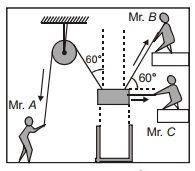
Mr. $A, B$ and $C$ are trying to put a heavy piston into a cylinder at a mechanical workshop in railway yard. If they apply forces $F_1, F_2$ and $F_3$ respectively on ropes then for which set of forces at that instant, they will be able to perform the said job?