MCQ
Two spheres A and B of exactly same mass are given equal positive and negative charges respectively. Their masses after charging.
- ARemains unaffected.
- BMass of A > mass of B.
- CMass of A < mass of B.
- DNothing can be said.
Generate a complete, print-ready paper with questions like this in minutes — across 16+ boards, with answer keys.
Two metallic plates A and B, each of area 5 ´ 10–4m2 are placed parallel to each other at a separation of 1 cm. Plate B carries a positive charge of 33.7 pc. A monochromatic beam of light, with photons of energy 5 eV each, starts falling on plate A at t = 0, so that 1016 photons fall on it per square meter per second. Assume that one photoelectron is emitted for every 106 incident photons. Also assume that all the emitted photoelectrons are collected by plate B and the work function of plate A remains constant at the value 2 eV. Electric field between the plates at the end of 10 seconds is
|
(a) 2 × 10³ N/C |
(b) 103 N/C |
(c) 5 × 10³ N/C |
(d) Zero |
The drift velocity does not depend upon
|
(a) Cross-section of the wire |
(b) Length of the wire |
|
(c) Number of free electrons |
(d) Magnitude of the current |
Four plates of the same area of cross-section are joined as shown in the figure. The distance between each plate is d. The equivalent capacity across A and B will be
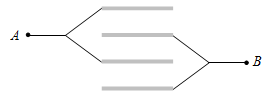
|
(a) |
(b) |
(c) |
(d) |
In producing X-rays a beam of electrons accelerated by a potential difference V is made to strike a metal target. For what value of V, X-rays will have the lowest wavelength of 0.3094 Å
| (a) 10 kV | (b) 20 kV | (c) 30 kV | (d) 40 kV |
Towards the centre of sun
|
(a) Density decreases |
(b) Pressure decreases |
|
(c) Temperature decreases |
(d) Density and pressure increases |
The idea of matter waves was given by
|
(a) Davisson and Germer |
(b) de-Broglie |
(c) Einstein |
(d) Planck |
Assertion : A star which appears blue will be much hotter than the sun
Reason : It is based on Wien's law
|
(a) If both assertion and reason are true and the reason is the correct explanation of the assertion. |
|
(b) If both assertion and reason are true but reason is not the correct explanation of the assertion. |
|
(c) If assertion is true but reason is false. |
|
(d) If the assertion and reason both are false. |


