Two spheres of the same material have radii $1\ m$ and $4\ m$ and temperatures $4000\ K$ and $2000\ K$ respectively. The ratio of the energy radiated per second by the first sphere to that by the second is
Medium


Download our appand get started for free
Experience the future of education. Simply download our apps or reach out to us for more information. Let's shape the future of learning together!No signup needed.*
Similar Questions
- 1$A$ cylinder of radius $R$ made of a material of thermal conductivity ${K_1}$ is surrounded by a cylindrical shell of inner radius $R$ and outer radius $2R$ made of material of thermal conductivity ${K_2}$. The two ends of the combined system are maintained at two different temperatures. There is no loss of heat across the cylindrical surface and the system is in steady state. The effective thermal conductivity of the system isView Solution
- 2Instantaneous temperature difference between cooling body and the surroundings obeying Newton's law of cooling is $\theta$. Which of the following represents the variation of $\ln \theta$ with time $t ?$View Solution
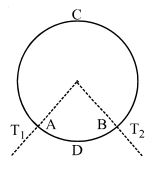
- 3Aring consisting of two parts $ADB$ and $ACB$ of same conductivity $k$ carries an amount of heat $H$. The $ADB$ part is now replaced with another metal keeping the temperatures $T_1$ and $T_2$ constant. The heat carried increases to $2H$. What $ACB$ should be the conductivity of the new$ADB$ part? Given $\frac{{ACB}}{{ADB}}= 3$View Solution
- 4A container with $1 kg$ of water in it is kept in sunlight, which causes the water to get warmer than the surroundings. The average energy per unit time per unit area received due to the sunlight is $700 Wm ^{-2}$ and it is absorbed by the water over an effective area of $0.05 m ^2$. Assuming that the heat loss from the water to the surroundings is governed by Newton's law of cooling, the difference (in ${ }^{\circ} C$ ) in the temperature of water and the surroundings after a long time will be. . . . . . . . (Ignore effect of the container, and take constant for Newton's law of cooling $=0.001 s ^{-1}$, Heat capacity of water $\left.=4200 J kg ^{-1} K ^{-1}\right)$View Solution
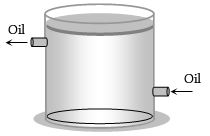
- 5The top of insulated cylindrical container is covered by a disc having emissivity $0.6$ and thickness $1\, cm$. The temperature is maintained by circulating oil as shown in figure. If temperature of upper surface of disc is $127^o C$ and temperature of surrounding is $27^o C$, then the radiation loss to the surroundings will be (Take $\sigma = \frac{{17}}{3} \times {10^{ - 8}}W/{m^2}{K^4})$View Solution
- 6View SolutionAt a common temperature, a block of wood and a block of metal feel equally cold or hot. The temperatures of block of wood and block of metal are
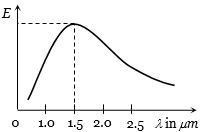
- 7In the figure, the distribution of energy density of the radiation emitted by a black body at a given temperature is shown. The possible temperature of the black body is ....... $K$View Solution
- 8Three rods of identical area of cross-section and made from the same metal form the sides of an isosceles triangle $ABC$, right angled at $B$. The points $A$ and $B$ are maintained at temperatures $T$ and $\sqrt 2 T$ respectively. In the steady state the temperature of the point C is ${T_C}$. Assuming that only heat conduction takes place, $\frac{{{T_C}}}{T}$ is equal toView Solution
- 9The energy spectrum of a black body exhibits a maximum around a wavelength ${\lambda _o}.$ The temperature of the black body is now changed such that the energy is maximum around a wavelength $\frac{{3{\lambda _o}}}{4}$.The power radiated by the black body will now increase by a factor ofView Solution
- 10Two spheres of same material have radius $1m$ and $4 m$ and temperature $4000K$ and $2000K$ respectively. The energy radiated per second by the first sphere isView Solution