MCQ
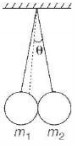
Two spherical objects each of radii $R$ and masses $m_1$ and $m_2$ are suspended using two strings of equal length $L$ as shown in the figure $(R << L)$. The angle $\theta$ which mass $m_2$ makes with the vertical is approximately
  • A
    $\frac{m_1 R}{\left(m_1+m_2\right) L}$
  • $\frac{2 m_1 R}{\left(m_1+m_2\right) L}$
  • C
    $\frac{2 m_2 h}{\left(m_1+m_2\right) L}$
  • D
    $\frac{m_2 R}{\left(m_1+m_2\right) L}$
Answer

Correct option: B.
$\frac{2 m_1 R}{\left(m_1+m_2\right) L}$
b
(b)

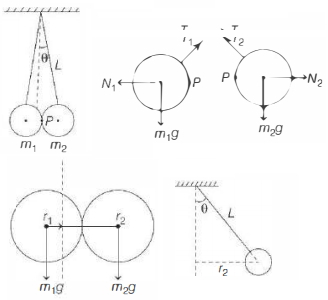
Given arrangement of spheres is as shown below.

Free body diagram of spheres is

As, there is no rotation about point of contact $P$.

Equating moments of weights about centre line, we get

$\quad m_1 g \times r_1=m_2 g \times r_2$

$\text { where, } r_1+r_2=2 R$

$\Rightarrow \quad \frac{m_2 r_2+r_2=2 R}{m_1}$

$\Rightarrow \quad r_2\left(\frac{m_2+m_1}{m_1}\right)=2 R \Rightarrow r_2=\frac{2 m_1 R}{m_1+m_2}$

Now, if angle made by string of $m_2$ with vertical line is $\theta$, then

$\sin \theta=\frac{r_2}{L} \Rightarrow \sin \theta=\left(\frac{2 m_1}{m_1+m_2}\right)\left(\frac{R}{L}\right)$

As $R \ll L$, angle $\theta$ is small, therefore $\sin \theta \approx \theta$.

$\therefore \quad \theta=\frac{2 m_1 R}{\left(m_1+m_2\right) L}$


Need a full question paper?

Generate a complete, print-ready paper with questions like this in minutes — across 16+ boards, with answer keys.

Start Generating Free

Similar questions

Sound velocity is maximum in
Two bodies having same mass $40\, kg$ are moving in opposite directions, one with a velocity of $10$$m/s$ and the other with $7\,m/s.$ If they collide and move as one body, the velocity of the combination is ........ $m/s$
A monoatomic gas performs a work of $\frac{Q}{4}$ where $Q$ is the heat supplied to it. The molar heat capaticy of the gas will be $R$ during this transformation. Where $R$ is the gas constant.
Three moles of an ideal gas $\left( {{C_P} = \frac{7}{2}R} \right)$ at pressure ${P_A}$ and temperature ${T_A}0$ is isothermally expanded to twice its initial volume. It is then compressed at constant pressure to its original volume. Finally the gas is compressed at constant volume to its original pressure ${P_A}.$ The correct $P-V$ and $P-T$ diagrams indicating the process are
Yellow light is refracted through a prism producing minimum deviation. If $i_1$ and $i_2$ denote the angle of incidence and emergence for the prism, then ..........
$200 \,g$ of ice at $-20^{\circ} C$ is mixed with $500 \,g$ of water at $20^{\circ} C$ in an insulating vessel. Final mass of water in vessel is ........... $g$ (specific heat of ice $=0.5 \,cal g ^{-10} C ^{-1}$ )
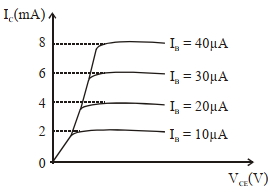
The typical output characteristics curve for a transistor working in the common-emitter configuration is shown in the figure.

The estimated current gain from the figure is

Which of the following orbits is a possible orbit for a planet ?
$A$ small sphere is moving at $a$ constant speed in $a$ vertical circle. Below is a list of quantities that could be used to describe some aspect of the motion of the sphere.

$I$ - kinetic energy

$II$- gravitational potential energy

$III$ - momentum

Which of these quantities will change as this sphere moves around the circle?

A particle moves in a circle of radius $R$, with a constant speed $v$. Then, during a time interval $[\pi R/3v]$, which of the following is true?