MCQ
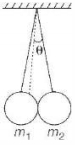
Two spherical objects each of radii $R$ and masses $m_1$ and $m_2$ are suspended using two strings of equal length $L$ as shown in the figure $(R << L)$. The angle $\theta$ which mass $m_2$ makes with the vertical is approximately
  • A
    $\frac{m_1 R}{\left(m_1+m_2\right) L}$
  • $\frac{2 m_1 R}{\left(m_1+m_2\right) L}$
  • C
    $\frac{2 m_2 h}{\left(m_1+m_2\right) L}$
  • D
    $\frac{m_2 R}{\left(m_1+m_2\right) L}$
Answer

Correct option: B.
$\frac{2 m_1 R}{\left(m_1+m_2\right) L}$
b
(b)

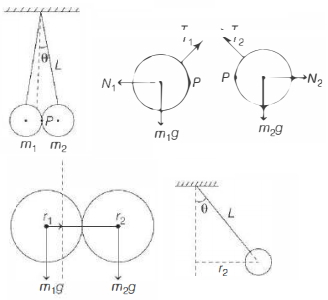
Given arrangement of spheres is as shown below.

Free body diagram of spheres is

As, there is no rotation about point of contact $P$.

Equating moments of weights about centre line, we get

$\quad m_1 g \times r_1=m_2 g \times r_2$

$\text { where, } r_1+r_2=2 R$

$\Rightarrow \quad \frac{m_2 r_2+r_2=2 R}{m_1}$

$\Rightarrow \quad r_2\left(\frac{m_2+m_1}{m_1}\right)=2 R \Rightarrow r_2=\frac{2 m_1 R}{m_1+m_2}$

Now, if angle made by string of $m_2$ with vertical line is $\theta$, then

$\sin \theta=\frac{r_2}{L} \Rightarrow \sin \theta=\left(\frac{2 m_1}{m_1+m_2}\right)\left(\frac{R}{L}\right)$

As $R \ll L$, angle $\theta$ is small, therefore $\sin \theta \approx \theta$.

$\therefore \quad \theta=\frac{2 m_1 R}{\left(m_1+m_2\right) L}$


Need a full question paper?

Generate a complete, print-ready paper with questions like this in minutes — across 16+ boards, with answer keys.

Start Generating Free

Similar questions

A simple pendulum with bob of mass $m$ and length $x$ is held in position at an angle $\theta_1$ and then angle $\theta_2$ with the vertical. When released from these positions, speeds with which it passes the lowest positions are $v_1$ and $v_2$ respectively. Then, $\frac{v_1}{v_2}$ is .............
A body of mass $m$ moving with velocity $v$ makes a head on perfectly inelastic collision with another body of mass $2\,m$ which is initially at rest. Then percentage loss in the kinetic energy 
Three masses $m,\,2\,m$ and $3\,m$ are moving in $x-y$ plane with speed $3\,u,\,2\,u\,$ and $u$ respectively as shown in figure. The three masses collide at the same point at $P$ and stick together. The velocity of resulting mass will be
A trolley of mass $m_1$ is placed on horizontal rigid pair of rails at same height. A mass $m_2$ is suspended to the trolley vertically by me ans of a ideal massless rope. The rope hangs between rails without touching them. Trolley can move along smooth rails but can't move in any other direction. Suspended mass is given small oscillation and perform $SHM$ after displacing small from stable equilibrium position in two ways, first perpendicular to the rails and second parallel to the rails. The ratio of time period of these (second case to first case) two $SHM's$ is
One Mach number is equal to
A steady flow of water passes along a horizontal tube from a wide section $X$ to the narrower section $Y$, see figure. Manometers are placed at $P$ and $Q$ at the sections. Which of the statements $A, B, C, D, E$ is most correct?
The velocity of a particle executing SHM varies with displacement $( x )$ as $4 v ^2=50- x ^2$. The time period of oscillations is $\frac{x}{7} s$. The value of $x$ is $............$ $\left(\right.$ Take $\left.\pi=\frac{22}{7}\right)$
The equation of state corresponding to $8 \,g$ of ${O_2}$ is
$Assertion$ : The position of centre of mass of a body depends upon shape and size of the body.
$Reason$ : Centre of mass of a body lies always at the centre of the body.
Cofficient of performance of refigerator is