Question
Two statements are given-one labelled Assertion (A) and the other labelled Reason (R). Select the correct answer to these questions from the codes (a), (b), (c) and (d) as given below.
  1. Both A and R are true and R is the correct explanation of A.
  2. Both A and R are true but R is not the correct explanation of A.
  3. A is true but R is false.
  4. A is false and R is also false.
Assertion: Optical fibers are used to transmit light without any loss in its intensity over distance of several kilometers.
Reason: Optical fibers are very thick and all the light is passed through it without any loss.
Answer

  1. A is true but R is false.
Explantion:
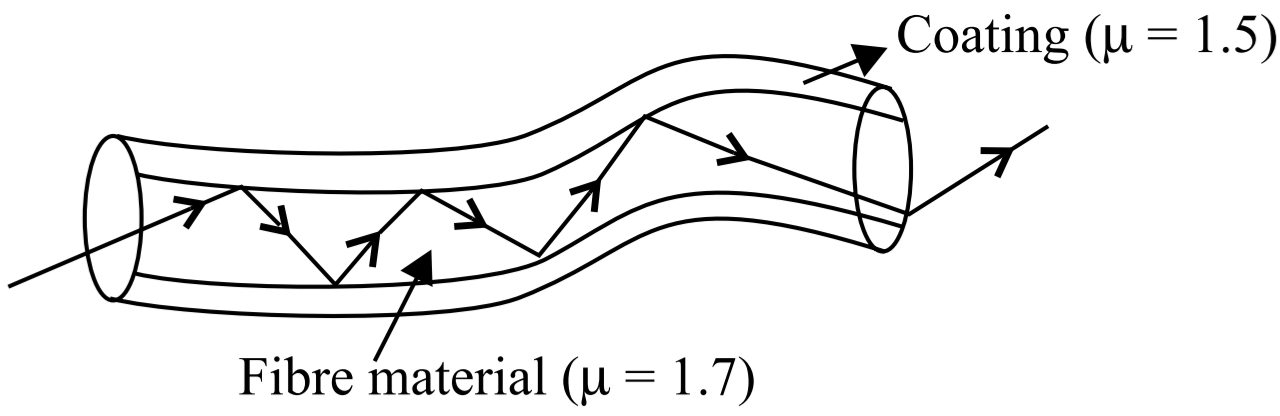
Optical fiber is extremely thin (radius of few microns) and long strand of very fine quality glass or quartz. When tight is incident at a small angle at one end, it gets refracted into the strands (or fibres) and incident on the interface of the fibres and the coating. The angle of incidence being greater than the critical angle, the ray of light undergoes total internal reflections. It suffers the internal reflection again and again, till the angle of incidence remains greater than the critical angle for fibre material with respect to coating. Due to successive total internal reflection there is no loss of intensity in optical fibres.

Need a full question paper?

Generate a complete, print-ready paper with questions like this in minutes — across 16+ boards, with answer keys.

Start Generating Free

Similar questions

Two statements are given-one labelled Assertion (A) and the other labelled Reason (R). Select the correct answer to these questions from the codes (a), (b ), (c) and (d) as given below.
  1. Both A and R are true and R is the correct explanation of A.
  2. Both A and Rare true but R is NOT the correct explanation of A.
  3. A is true but R is false.
  4. A is false and R is also false.
Assertion (A): An induced current is developed when the number of magnetic lines of force associated with conductor is changed.
Reason (R): An induced current develop in a conductor moved in a direction parallel to the magnetic field.
For question two statements are given-one labelled Assertion (A) and the other labelled Reason (R). Select the correct answer to these questions from the codes (a), (b), (c) and (d) as given below.
  1. Both A and R are true and R is the correct explanation of A.
  2. Both A and R are true but R is NOT the correct explanation of A.
  3. A is true but R is false.
  4. A is false and R is also false.
Assertion (A): Light added to light can produce darkness.
Reason (R): The destructive interference of two coherent light sources may give dark fringe.
For two statements are given-one labelled Assertion (A) and the other labelled Reason (R). Select the correct answer to these questions from the codes (a), (b), (c) and (d) as given below.
  1. Both A and R are true and R is the correct explanation of A.
  2. Both A and R are true but R is not the correct explanation of A.
  3. A is true but R is false.
  4. A is false and R is also false.
Assertion: Step-down transformer increases the current.
Reason: Transformer obeys the law of conservation of energy.
Two statements are given-one labelled Assertion (A) and the other labelled Reason (R). Select the correct answer to these questions from the codes (a), (b), (c) and (d) as given below.
  1. Both A and R are true and R is the correct explanation of A.
  2. Both A and R are true but R is NOT the correct explanation of A.
  3. A is true but R is false.
  4. A is false and R is also false.
Assertion (A): When two long parallel wires, hanging freely are connected in parallel to a battery, they come closer to each other.
Reason (R): Wires carrying current in opposite direction repel each other.
Assertion  (A): If the distance between parallel plates a capacitor is halved and dielectric constant is made three times then the capacitance becomes six times.
Reason (R) : Capacitance of the capacitor does not depend upon the nature of the material of the plates of the capacitor.
Two statements are given-one labelled Assertion (A) and the other labelled Reason (R). Select the correct answer to these questions from the codes (a), (b), (c) and (d) as given below.
  1. Both A and R are true and R is the correct explanation of A.
  2. Both A and R are true but R is NOT the correct explanation of A.
  3. A is true but R is false.
  4. A is false and R is also false.
Assertion (A): An ammeter is connected in series in the circuit.
Reason (R): An ammeter is a high resistance galvanometer.
For two statements are given$-$one labelled Assertion $(A)$ and the other labelled Reason $(R).$ Select the correct answer to these questions from the codes $(a), (b), (c)$ and $(d)$ as given below.
Assertion: Two bulbs of same wattage, one having a carbon filament and the other having a metallic filament are connected in series. Metallic bulbs will glow more brightly than carbon filament bulb.
Reason: Carbon is a semiconductor.
Assertion (A): The de Broglie wavelength of a molecule varies inversely as the square root of temperature.
Reason (R): The root mean square velocity of the molecule depends on the temperature.
For two statements are given$-$one labelled Assertion $(A)$ and the other labelled Reason $(R).$ Select the correct answer to these questions from the codes $(a), (b), (c)$ and $(d)$ as given below.
  1. Both $A$ and $R$ are true, and $R$ is the correct explanation of $A.$
  2. Both $A$ and $R$ are true, but $R$ is not the correct explanation of $A.$
  3. $A$ is true but $R$ is false.
  4. $A$ is false and $R$ is also false.
Assertion $(A):$ The electric tines of forces diverges from a positive charge and converge at a negative charge.
Reason $(A): A$ charged particle free to move in an electric field always move along an electric line of force.
For question two statements are given-one labelled Assertion (A) and the other labelled Reason (R). Select the correct answer to these questions from the codes (a), (b), (c) and (d) as given below.
  1. Both A and R are true, and R is the correct explanation of A.
  2. Both A and R are true, but R is NOT the correct explanation of A.
  3. A is true, but R is false.
  4. A is false and R is also false.
Assertion (A): Bohr had postulated that the electrons in stationary orbits around the nucleus do not radiate.
Reason (R): According to classical physics, all moving electrons radiate.