Question
Two statements are given-one labelled Assertion (A) and the other labelled Reason (R). Select the correct answer to these questions from the codes (a), (b), (c) and (d) as given below.
  1. Both A and R are true and R is the correct explanation of A.
  2. Both A and R are true but R is not the correct explanation of A.
  3. A is true but R is false.
  4. A is false and R is also false.
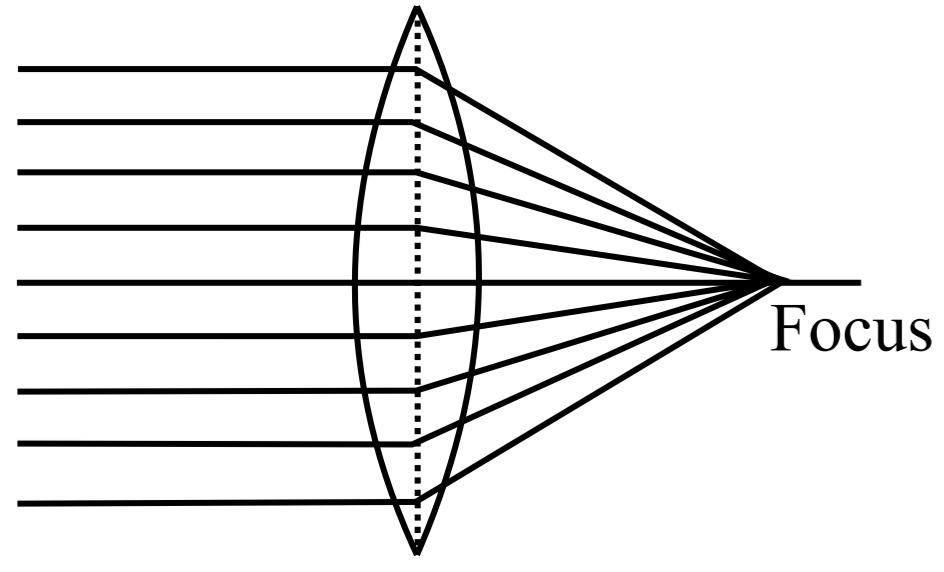
Assertion: The illuminance of an image produced by a convex lens is greater in the middle and less towards the edges.
Reason: The middle part of image is fanned by undeflected rays while outer part by inclined rays.
Answer

  1. Both A and R are true and R is the correct explanation of A.
Explanation:
Image formed by convex lens,

Need a full question paper?

Generate a complete, print-ready paper with questions like this in minutes — across 16+ boards, with answer keys.

Start Generating Free

Similar questions

Assertion (A): When ultraviolet light is incident on a photocell, its stopping potential is $V _0$ and the maximum kinetic energy of the photoelectrons is $K _{\max }$. When the ultraviolet light is replaced by X-rays, both $V _0$ and $K _{\max }$. increase.
Reason (R): Photoelectrons are emitted with speeds ranging from zero to a maximum value because of the range of frequencies present in the incident light.
For question, statements are given-one labelled Assertion (A) and the other labelled Reason (R). Select the correct answer to these questions from the codes (a) (b) (c) and (d) as given below.
  1. Both A and R are true, and R is the correct explanation of A.
  2. Both A and R are true, but R is NOT the correct explanation of A.
  3. A is true, but R is false.
  4. A is false and R is also false.
Assertion (A): The nuclear force becomes weak if the nucleus contains too many protons compared to neutrons.
Reason (R): The electrostatic forces weaken the nuclear force.
Two statements are given-one labelled Assertion (A) and the other labelled Reason (R). Select the correct answer to these questions from the codes (a), (b), (c) and (d) as given below.
  1. Both A and R are true and R is the correct explanation of A.
  2. Both A and R are true but R is NOT the correct explanation of A.
  3. A is true but R is false.
  4. A is false and R is also false.
Assertion (A): When current is represented by a straight line, the magnetic field will be circular.
Reason (R): According to Fleming's left hand rule, direction of force is parallel to the magnetic field.
For question two statements are given-one labelled Assertion (A) and the other labelled Reason (R). Select the correct answer to these questions from the codes (a), (b), (c) and (d) as given below.
  1. Both A and R are true and R is the correct explanation of A.
  2. Both A and R are true but R is NOT the correct explanation of A.
  3. A is true but R is false.
  4. A is false and R is also false.
Assertion (A): When tiny circular obstacle is placed in the path of light from some distance, a bright spot is seen at the centre of the shadow of the obstacle.
Reason (R): Destructive interference occurs at the centre of the shadow.
Two statements are given-one labelled Assertion (A) and the other labelled Reason (R). Select the correct answer to these questions from the codes (a), (b ), (c) and (d) as given below.
  1. Both A and R are true and R is the correct explanation of A.
  2. Both A and Rare true but R is NOT the correct explanation of A.
  3. A is true but R is false.
  4. A is false and R is also false.
Assertion (A): An aircraft flies along the meridian, the potential develops at the ends of its wings.
Reason (R): Whenever there is change in the magnetic flux e.m.f. induces.
For question two statements are given-one labelled Assertion (A) and the other labelled Reason (R). Select the correct answer to these questions from the codes (a), (b), (c) and (d) as given below.
  1. Both A and R are true and R is the correct explanation of A.
  2. Both A and R are true but R is NOT the correct explanation of A.
  3. A is true but R is false.
  4. A is false and R is also false.
Assertion (A): One of the condition for interference is that the two source should be very narrow.
Reason (R): One broad source is equal to large number of narrow sources.
For two statements are given-one labelled Assertion (A) and the other labelled Reason (R). Select the correct answer to these questions from the codes (a), (b), (c) and (d) as given below.
  1. Both A and R are true and R is the correct explanation of A.
  2. Both A and R are true but R is not the correct explanation of A.
  3. A is true but R is false.
  4. A is false and R is also false.
Assertion: Step-down transformer increases the current.
Reason: Transformer obeys the law of conservation of energy.
Assertion (A) : The quantity L/R possesses the dimension of time.
Reason (R): In order to reduce the rate of increase of current through a solenoid, we should increase the time constant.
For question two statements are given-one labelled Assertion (A) and the other labelled Reason (R). Select the correct answer to these questions from the codes (a), (b), (c) and (d) as given below.
  1. Both A and R are true and R is the correct explanation of A.
  2. Both A and R are true but R is NOT the correct explanation of A.
  3. A is true but R is false.
  4. A is false and R is also false.
Assertion (A): Newton's rings are formed in the reflected system. When the space between the lens and the glass plate is filled with a liquid of refractive index greater than that of glass, the central spot of the pattern is dark.
Reason (R): The reflections in Newton's ring cases will be from a denser to a rarer medium and the two interfering rays are reflected under similar conditions.
Two statements are given-one labelled Assertion (A) and the other labelled Reason (R). Select the correct answer to these questions from the codes (a), (b ), (c) and (d) as given below.
  1. Both A and R are true and R is the correct explanation of A.
  2. Both A and Rare true but R is NOT the correct explanation of A.
  3. A is true but R is false.
  4. A is false and R is also false.
Assertion (A): Changing magnetic flux can produce induced e.m.f.
Reason (R): Faraday established induced e.m.f. experimentally.