MCQ
Two statements are given$-$one labelled Assertion and the other labelled Reason. Select the correct answer to these questions from the codes $(a), (b), (c)$ and $(d)$ as given below.
Assertion: Bacteriophage vectors are more advantageous than plasmid vectors.
Reason: Bacteriophage vectors can be easily detected at the time of cloning experiments.
  • Both assertion and reason are true and reason is the correct explanation of assertion.
  • B
    Both assertion and reason are true but reason is not the correct explanation of assertion.
  • C
    Assertion is true but reason is false.
  • D
    Both assertion and reason are false.

Answer

Correct option: A.
Both assertion and reason are true and reason is the correct explanation of assertion.
Bacteriophage vector have two advantages over plasmid vectors.
$(i).$ They are more efficient than plasmids for the cloning of large $\text{DNA}$ fragments. For example, the largest cloned insert in lambda phage is $24\ kb$ while for plasmid vector it is less than $15\ kb.$
$(ii).$ It is easier to screen a large number of phage plaques than bacterial colonies for identification of recombinant vectors.

Need a full question paper?

Generate a complete, print-ready paper with questions like this in minutes — across 16+ boards, with answer keys.

Start Generating Free

Similar questions

Directions: In the following questions, the Assertions $(A)$ and Reason$(s) (R)$ have been put forward. Read both the statements carefully and choose the correct alternative from the following:
Assertion: Recognition site should be preferably single and responsive to commonly used restriction enzyme.
Reason: In $\text{pBR} 322$ alien $\text{DNA}$ is ligated generally in the area of Bam $- \text{HI}$ site of tetracycline resistance gene.
Directions: In the following questions, the Assertions $(A)$ and Reason$(s) (R)$ have been put forward. Read both the statements carefully and choose the correct alternative from the following:
Assertion: $\text{XX - XY}$ type of sex determination mechanism is an example of female heterogamety and is found in Drosophila.
Reason: Male heterogamety is seen in moths where males produce two different types of gamete.
Two statements are given$-$one labelled Assertion and the other labelled Reason. Select the correct answer to these questions from the codes $(a), (b), (c)$ and $(d)$ as given below.
Assertion: Whisky develops colour during the aging process.
Reason: Vodka is colourless.
For question two statements are given$-$one labelled Assertion and the other labelled Reason. Select the correct answer to these questions from the codes $(a), (b), (c)$ and $(d)$ as given below.
Assertion : Number of chromosomes in one genome is equal to number of linkage groups.
Reason: Two homologous chromosomes form a linkage group.
For two statements are given$-$one labelled Assertion and the other labelled Reason. Select the correct answer to these questions from the codes $(a), (b), (c)$ and $(d)$ as given below.
Assertion: Colpa a urea is a specialised pollinating agent of orchid Ophrys speculum.
Reason: Male Colpa mistakes the Ophrys flowers for female partner.
For two statements are given$-$one labelled Assertion and the other labelled Reason. Select the correct answer to these questions from the codes $(a), (b), (c)$ and $(d)$ as given below.
Assertion: Megaspore mother cell undergoes meiotic division.
Reason: All four megaspores form female gametophyte.
For question two statements are given$-$one labelled Assertion and the other labelled Reason. Select the correct answer to these questions from the codes $(a), (b), (c)$ and $(d)$ as given below.
Assertion : Spleen can be thought of as an immunologic conference centre.
Reason: Spleen helps only in digestion.
For two statements are given$-$one labelled Assertion and the other labelled Reason. Select the correct answer to these questions from the codes $(a), (b), (c)$ and $(d)$ as given below.
Assertion: Ubisch bodies are produced by glandular tape tum.
Reason: Ubisch bodies participated in the thickening of exine.
For two statements are given$-$one labelled Assertion and the other labelled Reason. Select the correct answer to these questions from the codes $(a), (b), (c)$ and $(d)$ as given below.
Assertion: A medical termination of pregnancy is legally allowed upto the $28^{th}$​​​​​​​ week of pregnancy.
Reason: $\text{MTP}$ is done if family physician or gynaecologist consider the need for abortion.
Read the following and answer any four questions from $(i)$ to $(v)$ given below:
Embryo develops at the micropylar end of the embryo sac, where the zygote is situated. Most zygotes divided only after certain amount of endosperm is formed. The early stages of embryo development are similar in both monocotyledons and dicotyledons. The zygote gives rise to the proembryo and subsequently to the globular heart-shaped and mature embryo. A typical dicotyledonous embryo consists of an embryonal axis and two cotyledons. Embryo of monocotyledons possess only one cotyledon.
  1. True embryo develops as a result of fusion of:
  1. Two polar nuclei of embryo sac.
  2. An egg cell and a male gamete.
  3. Synergid and male gamete.
  4. A male gamete and antipodals.
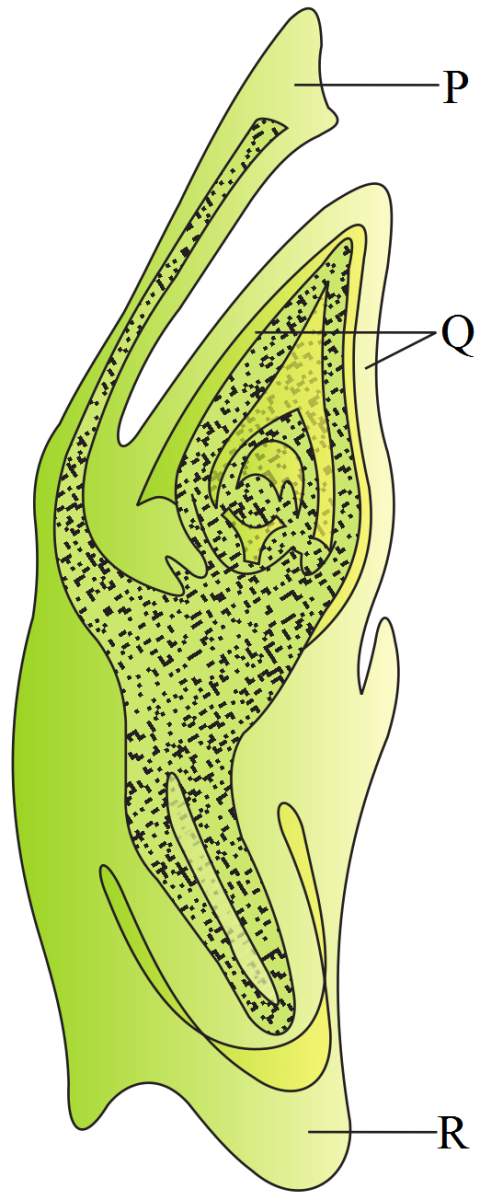
  1. Refer to the given diagram of the embryo of an angiospermous plant with parts labelled $P, Q$ and $R$. Select the correct statement$(s)$ regarding this.
  1. Part $'P\ '$ supplies nutrition to the developing embryo.
  2. Part $'Q\ '$ is the protective sheath of radicle and root cap.
  3. Part $'R\ '$ is the protective sheath of shoot apex and leaf primordia.
  4. The embryo shown in the diagram is present in members of Family Poaceae.
  1. $(IV)$ only.
  2. $(II)$ and $(III)$ only.
  3. $(I)$ and $(IV)$ only.
  4. $(I), (II), (III)$ and $(IV).$
  1. Which of the given statements are true?
  1. During the development of a dicot embryo, heart$-$shaped embryo is followed by globular embryo.
  2. The part of embryonal axis above the level of cotyledons is epicotyl, while the part below the level of cotyledons is hypocotyl.
  3. Monocot seeds possess a single cotyledon, represented by scutellum.
  1. $(I)$ and $(II).$
  2. $(II)$ and $(III).$
  3. $(I)$ and $(III).$
  4. $(I), (II)$ and $(III).$
  1. Consider the following parts of an embryonal axis of a dicot seed.
  1. Hypocotyl.
  2. Epicotyl.
  3. Radicle.
  4. Plumule.
In which of the following the above parts are correctly arranged from top to base?
  1. $(III) \rightarrow (I) \rightarrow (II) \rightarrow (IV).$
  2. $(II) \rightarrow (I) \rightarrow (III) \rightarrow (IV).$
  3. $(IV) \rightarrow (II) \rightarrow (I) \rightarrow (III).$
  4. $(III) \rightarrow (IV) \rightarrow (II) \rightarrow (I).$
  1. In grass family, the cotyledon, is called:
  1. Epiblast.
  2. Plumule.
  3. Scutellum.
  4. Perisperm.