Question
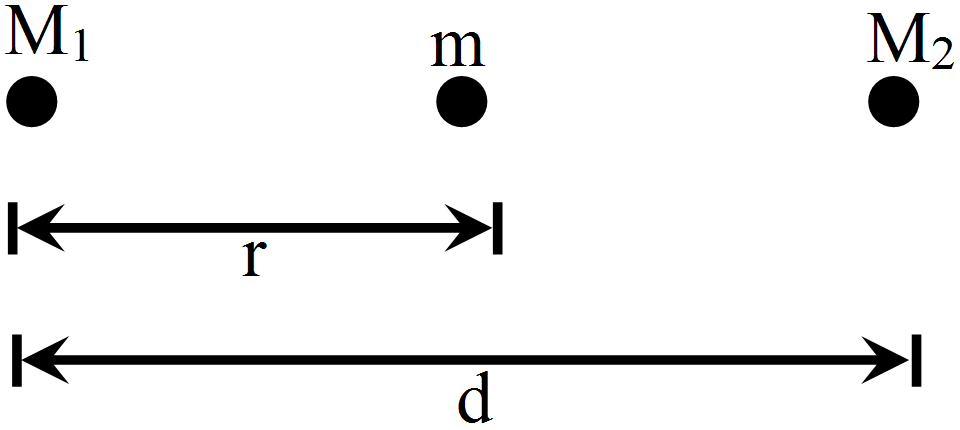
Two stationary particles of masses $M_1$ and $M_2$ are a distance d' apart. A third particle lying on the line joining the particles, experiences no resultant gravitational force. What is the distance of this particle from $M_1$?
Answer


The force on the third parcticle, say of mass m towards $M_1$ is
$\text{F}=\text{G}\frac{\text{GMm}}{\text{r}^2}$
The force on m towards $M_2$ is
$\text{F}=\text{G}\frac{\text{M}_2\text{m}}{(\text{d}-\text{r})^2}$
Equating the two forces, we have
$\text{G}\frac{\text{M}_1\text{m}}{\text{r}^2}=\text{G}\frac{\text{M}^2\text{m}}{(\text{d}-\text{r})^2}$
$\Big[\frac{\text{d}-\text{r}}{\text{r}}\Big]^2=\frac{\sqrt{\text{M}_2}}{\sqrt{\text{M}_1}}$
$\Rightarrow\frac{\text{d}}{\text{r}}-1=\frac{\sqrt{\text{M}_2}}{\sqrt{\text{M}}_1}$
$\Rightarrow\frac{\text{d}}{\text{r}}=\frac{\sqrt{\text{M}_2}+\sqrt{\text{M}_1}}{\sqrt{\text{M}_1}}$
$\Rightarrow\text{r}=\text{d}\Bigg[\frac{\sqrt{\text{M}_1}}{\sqrt{\text{M}_1+\sqrt{\text{M}_2}}}\Bigg]$

Need a full question paper?

Generate a complete, print-ready paper with questions like this in minutes — across 16+ boards, with answer keys.
Start Generating Free

Similar questions

What are the rules for rounding off a number? Explain each rule with examples.
The driver of a three-wheeler moving with a speed of 36km/h sees a child standing in the middle of the road and brings his vehicle to rest in 4.0s just in time to save the child. What is the average retarding force on the vehicle ? The mass of the three-wheeler is 400kg and the mass of the driver is 65kg.
In the previous problem, if $15.0cm$ of water and spirit each are further poured into the respective arms of the tube, what is the difference in the levels of mercury in the two arms? (Specific gravity of mercury = $13.6$)
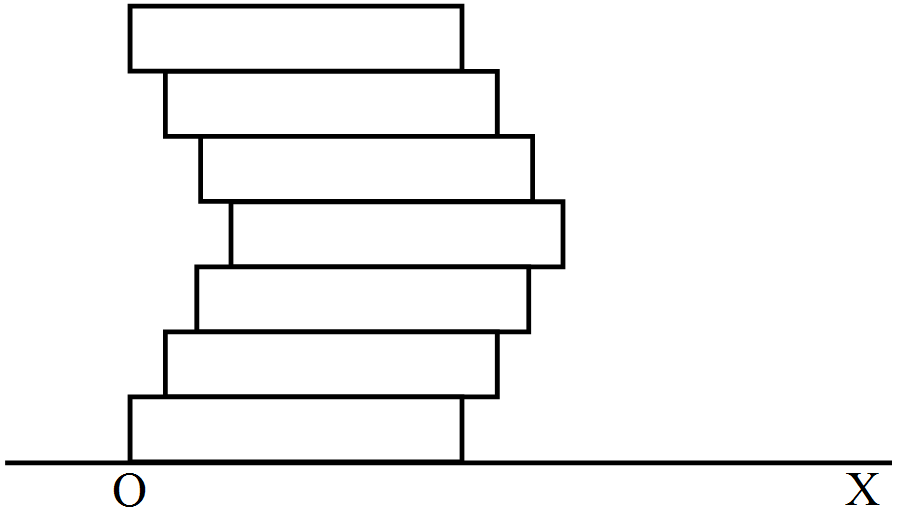
Seven homogeneous bricks, each of length L, are arranged as shown in figure. Each brick is displaced with respect to the one in contact by $\frac{\text{L}}{10}.$ Find the x-coordinate of the centre of mass relative to the origin shown.
A proton projected in a magnetic field of $0.020T$ travels along a helical path of radius $5.0cm$ and pitch $20cm$. Find the components of the velocity of the proton along and perpendicular to the magnetic field. Take the mass of the proton = $1.6 \times 10^{-27}kg$
A girl riding a bicycle with a speed of $5m/ s$ towards north direction, observes rain falling vertically down. If she increases her speed to $10m/ s$, rain appears to meet her at $45°$ to the vertical. What is the speed of the rain? In what direction does rain fall as observed by a ground based observer?
(Hint: Assume north to be $\hat{\text{i}}$ direction and vertically downward to be $-\hat{\text{j}}$. Let the rain velocity $\text{v}_\text{r}$ be $\text{a}\hat{\text{i}}+\text{b}\hat{\text{j}}.$ The velocity of rain as observed by the girl is always $V_r-V_{girl}$. Draw the vector diagram/s for the information given and find a and b. You may draw all vectors in the reference frame of ground based observer)
Consider a p-n junction diode having the characteristic $\text{i}-\text{i}_0\Big(\text{e}^{\frac{\text{eV}}{\text{kT}}}-1\Big)$ where $\text{i}_0=20\mu\text{A}.$ The diode is operated at T = 300K.
  1. Find the current through the diode when a voltage of 300mV is applied across it in forward bias.
  2. At what voltage does the current double?
A beam of white light is incident normally on a plane surface absorbing 70% of the light and reflecting the rest. If the incident beam carries 10W of power, find the force exerted by it on the surface.
Fig. shows two blocks of masses 5kg and 2kg placed on a frictionless surface and connected by a spring. An external kick gives a velocity 14 m/ s to the heavier block in the direction of lighter one. Deduce (i) the velocity gained by the centre of mass and (ii) the separate velocities of the two blocks in the centre of mass coordinates just after the kick.
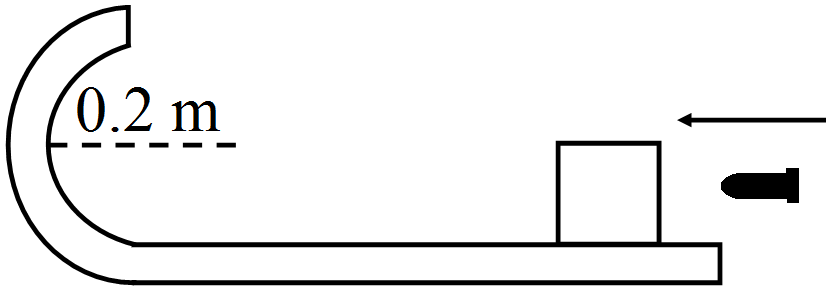
A bullet of mass $10g$ moving horizontally at a speed of $5017m/s$ strikes a block of mass $490g$ kept on a frictionless track as shown in figure. The bullet remains inside the block and the system proceeds towards the semicircular track of radius $0.2m$. Where will the block strike the horizontal part after leaving the semicircular track ?