MCQ
Two steel wires having same length are suspended from a ceiling under the same load. If the ratio of their energy stored per unit volume is $1: 4,$ the ratio of their diameters is
  • A
    $1: \sqrt{2}$
  • B
    $1: 2$
  • C
    $2:1$
  • $\sqrt{2}: 1$

Answer

Correct option: D.
$\sqrt{2}: 1$
d
$\frac{\text { Energystored }}{\text { Volume }}=\frac{1}{2} \frac{(\text { Stress })^{2}}{\mathrm{Y}}$

$\frac{\mathrm{u}_{1}}{\mathrm{u}_{2}}=\frac{1}{4} \Rightarrow 4 \mathrm{u}_{1}=\mathrm{u}_{2}$

$4 \frac{1}{2 \mathrm{Y}}\left[\frac{\mathrm{W} \cdot 4}{\pi \mathrm{d}_{1}^{2}}\right]^{2}=\frac{1}{2 \mathrm{Y}}\left[\frac{\mathrm{W} \cdot 4}{\pi \mathrm{d}_{2}^{2}}\right]^{2}$

$4=\left(\frac{\mathrm{d}_{1}}{\mathrm{d}_{2}}\right)^{4}$

$\Rightarrow \frac{\mathrm{d}_{1}}{\mathrm{d}_{2}}=\sqrt{2}: 1$

Need a full question paper?

Generate a complete, print-ready paper with questions like this in minutes — across 16+ boards, with answer keys.
Start Generating Free

Similar questions

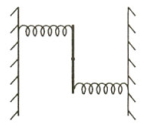
A uniform rod of length $L$ and mass $M$ is pivoted at the centre. Its two ends are attached to two springs of equal spring constants $k$. The springs are fixed to rigid supports as shown in the figure, and the rod is free to oscillate in the horizontal plane. The rod is gently pushed through a small angle $\theta$ in one direction and released. The frequency of oscillation is
At time $t = 0$ , a $2\, kg$ particle has position vector $\vec r = \left( {4\hat i - 2\hat j} \right)\,m$ relative to the origin. Its velocity is given by $\vec v = 2{t^2}\hat i\,\left( {m/s} \right)$. The torque acting on the particle about the origin at $t = 2\,s$, is ........ $\hat k\,N - m$
In a triclinic crystal system
The activity of a sample is $ 64 \times 10^{-5}\ Ci$ . Its half-life $3$ days. The activity will become$5 \times {10^{ - 6}}\ Ci$ after ........... $days$
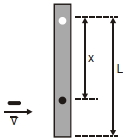
A rod of mass $m$ and length $L$, pivoted at one of its ends, is hanging vertically. A bullet of the same mass moving at speed $v$ strikes the rod horizontally at a distance $x$ from its pivoted end and gets embedded in it. The combined system now rotates with angular speed $\omega$ about the pivot. The maximum angular speed $\omega_M$ is achieved for $x=x_M$. Then

$(A)$ $\omega=\frac{3 v x}{ L ^2+3 x^2}$

$(B)$ $\omega=\frac{12 v x}{L^2+12 x^2}$

$(C)$ $x_M=\frac{L}{\sqrt{3}}$

$(D)$ $\omega_M=\frac{v}{2 L} \sqrt{3}$
If a unit vector is represented by $0.5\hat i + 0.8\hat j + c\hat k$, then the value of ‘$c$’ is
Consider two spherical planets of same average density. Second planet is $8$ times as massive as first planet. The ratio of the acceleration due to gravity of the second planet to that of the first planet is
Three point masses ${m_1},\,{m_2},\,{m_3}$ are located at the vertices of an equilateral triangle of length $'a'$. The moment of inertia of the system about an axis along the altitude of the triangle passing through ${m_1}$ is 
A fixed volume of iron is drawn into a wire of length $L.$ The extension $x$ produced in this wire by a constant force $F$ is proportional to
When $_{90}T{h^{228}}$ transforms to $_{83}B{i^{212}}$, then the number of the emitted  $\alpha$- and $\alpha$- particles is, respectively