MCQ
Two stones are projected with the same speed but making different angles with the horizontal. Their ranges are equal. If the angle of projection of one is $\pi /3$ and its maximum height is $h_1$ then the maximum height of the other will be
  • A
    $3h_1$
  • B
    $2h_1$
  • C
    $h_1/2$
  • $h_1/3$

Answer

Correct option: D.
$h_1/3$
d
$\frac{\mathrm{h}_{2}}{\mathrm{h}_{1}}=\frac{\mathrm{u}^{2} \sin ^{2} \theta_{2}}{2 \mathrm{g}} \times \frac{2 \mathrm{g}}{\mathrm{u}^{2} \sin ^{2} \theta_{1}}$

$=\frac{\sin ^{2} \theta_{2}}{\sin ^{2} \theta_{1}}=\frac{\sin ^{2} \pi / 6}{\sin ^{2} \pi / 3}=\frac{1}{3}$

$\therefore \quad \mathrm{h}_{2}=\mathrm{h}_{1} / 3$

Need a full question paper?

Generate a complete, print-ready paper with questions like this in minutes — across 16+ boards, with answer keys.

Start Generating Free

Similar questions

A man is climbing up a spiral type of staircase. His degrees of freedom are:
An object thrown vertically upwards with a velocity of $25\ m/ s$ takes $4\ sec$ to reach the thrower. What is displacement of the object?
A transverse harmonic wave on a string is described by $y = 3 \sin \,(36t + 0.018x + \frac{\pi}{4})$ where $x$ and $y$ are in $cm$ and $t$ in $s$. The least distance between  two sucessive crests in the wave is .... $m$
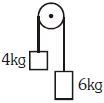
Two bodies of mass $4 \,kg$ and $6\, kg$ are tied to the ends of a massless string. The string passes over a pulley which is frictionless (see figure). The acceleration of the system in terms of acceleration due to gravity $(g)$ is 
$A$ uniform cylinder of mass $m$ can rotate freely about its own axis which is horizontal.$A$ particle of mass mo hangs from the end of a light string wound round the cylinder which does not slip over it. When the system is allowed to move, the acceleration of the descending mass will be
A body of mass $m$ is projected at an angle of ${45^o}$ with the horizontal. If air resistance is negligible, then total change in momentum when it strikes the ground is
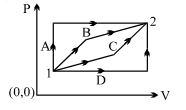
An ideal gas is taken from state $1$ to state $2$ through optional path $A, B, C \& D$ as shown in $P-V$ diagram. Let $Q, W$ and $U$ represent the heat supplied, work done $\&$ internal energy of the gas respectively. Then
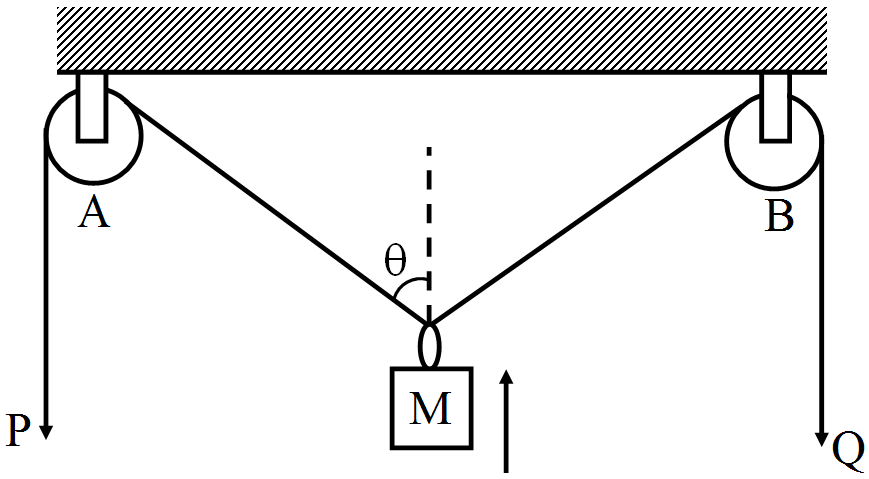
In the arrangement shown in figure, the ends P and Q of an inextensible string move downwards with uniform speed u. Pulleys A and B are fixed. The mass M moves upwards with a speed:
A block of mass $10\, kg$ is placed on an inclined plane. When the angle of inclination is $30°$, the block just begins to slide down the plane. The force of static friction is ....... $kg\, wt$
A flask contains hydrogen and oxygen in the ratio of $2: 1$ by mass at temperature $27^{\circ} C$. The ratio of average kinetic energy per molecule of hydrogen and oxygen respectively is :