MCQ
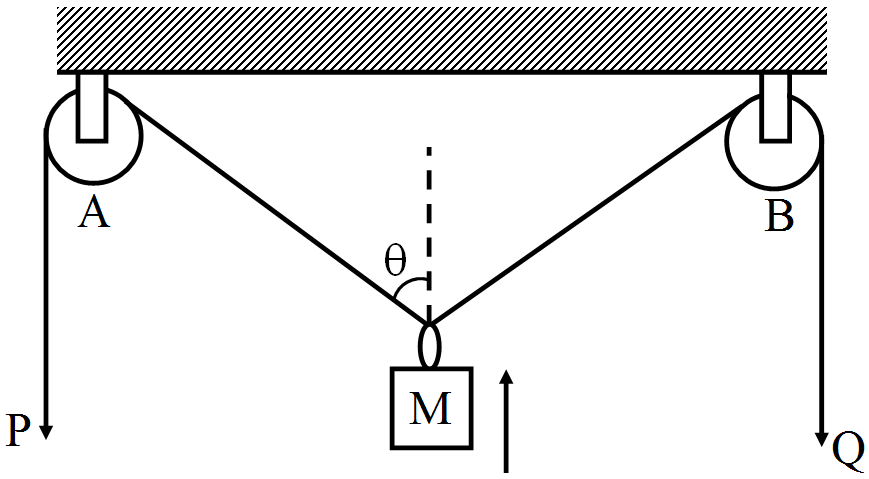
In the arrangement shown in figure, the ends P and Q of an inextensible string move downwards with uniform speed u. Pulleys A and B are fixed. The mass M moves upwards with a speed:
  • A
    $2\text{u}\cos\theta$
  • $\frac{\text{u}}{\cos\theta}$
  • C
    $\frac{\text{2u}}{\cos\theta}$
  • D
    $\text{u}\cos\theta$

Answer

Correct option: B.
$\frac{\text{u}}{\cos\theta}$


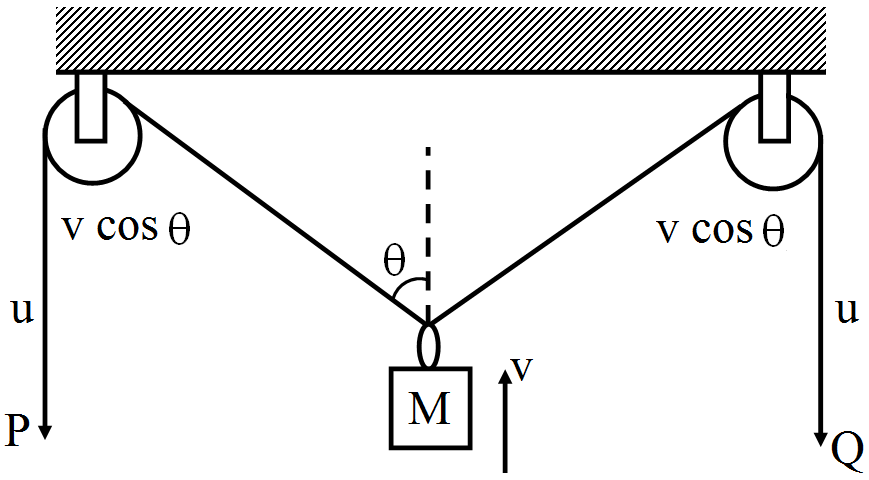
Along the string, the velocity of each object is the same.
$2\text{v}\cos(\theta)=2\text{u}$
$\text{v}=\frac{\text{u}}{\cos(\theta)}$

Need a full question paper?

Generate a complete, print-ready paper with questions like this in minutes — across 16+ boards, with answer keys.

Start Generating Free

Similar questions

A ball is dropped vertically downwards from a height $h$ above the ground. It hits the ground inelastically and bounces up vertically. Neglecting subsequent motion and air resistance, which of the following graph represents variation between speed $(v)$ and height $(h)$ correctly?
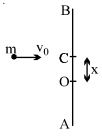
$A$ uniform rod $AB$ of length $L$ and mass $M$ is lying on a smooth table. $A$ small particle of mass $m$ strike the rod with a velocity $v_0$ at point $C$ at a distance $x$ from the centre $O$. The particle comes to rest after collision. The value of $x$, so that point $A$ of the rod remains ststionary just after collision is:
Let $T_1$ and $T_2$ be the time periods of two springs $A$ and $B$ when a mass $m$ is suspended from them separately. Now both the springs are connected in parallel  and same mass $m$ is suspended with them. Now let $T$ be the time period in this position. Then
Two blocks $1$ and $2$ of equal mass $m$ are connected by an ideal string (see figure below) over a frictionless pulley. The blocks are attached to the ground by springs having spring constants $k_1$ and $k_2$ such that $k_1 > k_2$. Initially, both springs are unstretched. Block $1$ is slowly pulled down a distance $x$ and released. Just after the release the possible values of the magnitudes of the accelerations of the blocks $a_1$ and $a_2$ can be
A particle is acted upon by a force $F$ which varies with position $x$ as shown in the figure. If the particle at $x = 0$ has the kinetic energy of $25J,$ then the kinetic energy of the particle at $x = 16m$ is?
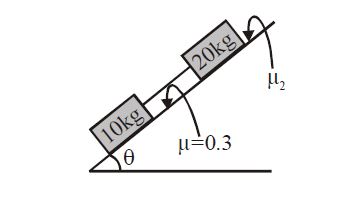
Value of $\theta$  is increased gradually from $\theta  = 0$ At $\theta=tan^{-1}(\frac{1}{2})$ both the block just start slipping. Then value of $\mu_2$ is : $(g = 10 m/s^2)$
In cold countries, water pipes sometimes burst, because
A gaseous mixture contains equal number of hydrogen and nitrogen molecules. Specific heat measurements on this mixture at temperatures below $100\, K$ would indicate that the value of $\gamma $ (ratio of specific heats) for this mixture is
Work done on an object does not depend
Two sound waves move in the same direction in the same medium. The pressure amplitudes of the waves are equal but the wavelength of the first wave is double the second. Let the average power transmitted across a cross$-$section by the first wave be $\mathrm{P}_1$ and that by the $1$ second wave be $\mathrm{P}_2$. Then,