MCQ
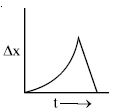
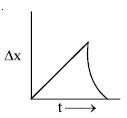
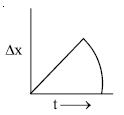
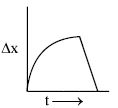
Two stones are thrown up vertically and simultaneously but with different speeds. Which graph correctly represents the time variation of their relative positions $\Delta x$.Assume that stones do not bounce after hitting ground.
  • A

  • B


  • D

Answer

Correct option: C.

c

Need a full question paper?

Generate a complete, print-ready paper with questions like this in minutes — across 16+ boards, with answer keys.

Start Generating Free

Similar questions

One mole of an ideal gas at an initial temperature of $T\, K$ does $6\, R\, joules$ of work adiabatically. If the ratio of specific heats of this gas at constant pressure and at constant volume is $\frac{5}{3}$ , the final temperature of gas will be
A quarter horse power motor runs at a speed of $ 600 r.p.m.$  Assuming $40\%$  efficiency the work done by the motor in one rotation will be
An electron from various excited states of hydrogen atom emits radiation to come to the ground state. Let $\lambda_n, \lambda_g$ be the de Broglie wavelength of the electron in the $n ^{\text {th }}$ state and the ground state respectively. Let $\Lambda_n$ be the wavelength of the emitted photon in the transition from the $n ^{\text {th }}$ state to the ground state. For large $n , ~(A, B$ are constants)
The Rydberg constant $R$ for hydrogen is
Which of the following speed-time $(v-t)$ graphs is physically not possible?
A source supplies heat to a system at the rate of $1000 \,W$. If the system performs work at a rate of $200\,W$. The rate at which internal energy of the system increases $.......\,W$
In the absence of other conductors, the surface charge density
An unpolarised light beam of intensity $2 I _{0}$ is passed through a polaroid $P$ and then through another polaroid $Q$ which is oriented in such a way that its passing axis makes an angle of $30^{\circ}$ relative to that of $P$. The intensity of the emergent light is.
A packet contains silver powder of mass $20.23 \,g \pm 0.01 \,g$. Some of the powder of mass $5.75 \,g \pm 0.01 \,g$ is taken out from it. The mass of the powder left back is ................
An ideal heat engine exhausting heat at ${77^o}C$ is to have a $30\%$ efficiency. It must take heat at ...... $^oC$