Question
Two straight horizontal parallel wires are carrying the same current in the same direction, $d$ is the distance between the wires. You are provided with a small freely suspended magnetic needle. At which of the following positions will the orientation of the needle be independent of the magnitude of the current in the wires
Answer

(d) At these points, the resultant field $ = 0$

Need a full question paper?

Generate a complete, print-ready paper with questions like this in minutes — across 16+ boards, with answer keys.

Start Generating Free

Similar questions

A car moving with a speed of $40\, km/h$ can be stopped by applying brakes after atleast $2\, m$. If the same car is moving with a speed of $80 \,km/h$, what is the minimum stopping distance............$m$
Soap helps in cleaning clothes, because
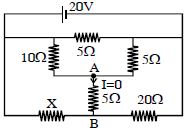
In given circuit current through $AB$ is zero, then what will be the value of unknown resistance $'X'$ ............... $\Omega$
If $Q$ is the charge on the plates of a capacitor of capacitance $C, V$ the potential difference between the plates, $A$ the area of each plate and $d $ the distance between the plates, the force of attraction between the plates is
For a spherical shell
One mole of an ideal monoatomic gas undergoes the following four reversible processes:

Step $1$ It is first compressed adiabatically from volume $8.0 \,m ^{3}$ to $1.0 \,m ^{3}$.

Step $2$ Then expanded isothermally at temperature $T_{1}$ to volume $10.0 \,m ^{3}$.

Step $3$ Then expanded adiabatically to volume $80.0 \,m ^{3}$.

Step $4$ Then compressed isothermally at temperature $T_{2}$ to volume $8.0 \,m ^{3}$.

Then, $T_{1} / T_{2}$ is

$\begin{array}{*{20}{c}}
  {2C{H_3} - C - C{H_3}} \\ 
  {\,\,||} \\ 
  {\,\,\,O} 
\end{array}$ $\xrightarrow[{^{{H^ + }}}]{{Mg/Hg}}$ Product, product in the reaction is
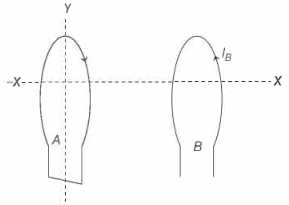
The diagram below shows two circular loops of wire ( $A$ and $B$ ) centred on and perpendicular to the $X$-axis and oriented with their planes parallel to each other. The $Y$-axis passes vertically through loop $A$ (dashed line). There is a current $I_B$ in loop $B$ as shown in the diagram. Possible actions which we might perform on loop $A$ are

$(I)$ move $A$ to the right along $X$-axis closer to $B$

$(II)$ move $A$ to the left along $X$-axis away from $B$

$(III)$ as viewed from above, rotate $A$ clockwise about $Y$-axis

$(IV)$ as viewed from above, rotate $A$ anti-clockwise about $Y$-axis

Which of the actions will induce a current in $A$ only in the direction shown?

A metallic ring is dropped down, keeping its plane perpendicular to a constant and horizontal magnetic field. The ring enters the region of magnetic field at $t = 0$ and completely emerges out at $t = T\,sec$. The current in the ring varies as
A simple pendulum of length $L$ and mass (bob) $M$ is oscillating in a plane about a vertical line between angular limits $ - \varphi $ and $ + \varphi $. For an angular displacement $\theta (|\theta | < \varphi )$, the tension in the string and the velocity of the bob are $T$ and $ v$ respectively. The following relations hold good under the above conditions