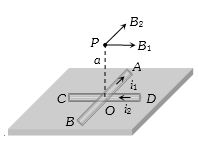
Two straight long conductors $AOB$ and $COD$ are perpendicular to each other and carry currents ${i_1}$ and ${i_2}$. The magnitude of the magnetic induction at a point $ P$ at a distance a from the point $O$ in a direction perpendicular to the plane $ACBD$ is
Medium
Download our app for free and get started
(c) At $P$ : ${B_{net}} = \sqrt {B_1^2 + B_2^2} $
$ = \sqrt {{{\left( {\frac{{{\mu _0}}}{{4\pi }}\frac{{2{i_1}}}{a}} \right)}^2} + {{\left( {\frac{{{\mu _0}}}{{4\pi }}\frac{{2{i_2}}}{a}} \right)}^2}} $
$ = \frac{{{\mu _0}}}{{2\pi a}}{(i_1^2 + i_2^2)^{1/2}}$
$ = \sqrt {{{\left( {\frac{{{\mu _0}}}{{4\pi }}\frac{{2{i_1}}}{a}} \right)}^2} + {{\left( {\frac{{{\mu _0}}}{{4\pi }}\frac{{2{i_2}}}{a}} \right)}^2}} $
$ = \frac{{{\mu _0}}}{{2\pi a}}{(i_1^2 + i_2^2)^{1/2}}$

Download our appand get started for free
Experience the future of education. Simply download our apps or reach out to us for more information. Let's shape the future of learning together!No signup needed.*
Similar Questions
- 1View SolutionTwo electrons are moving along parallel lines unidirectionarly with same velocity they will
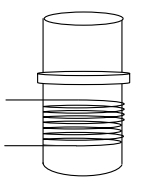
- 2$STATEMENT-1$ A vertical iron rod has a coil of wire wound over it at the bottom end. An alternating current flows in the coil. The rod goes through a conducting ring as shown in the figure. The ring can float at a certain height above the coil. BecauseView Solution
$STATEMENT- 2$ In the above situation, a current is induced in the ring which interacts with the horizontal component of the magnetic field to produce an average force in the upward direction.
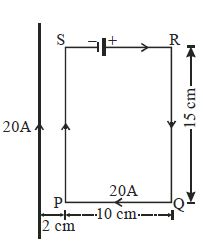
- 3The resultant force on the current loop $PQRS$ due to a long current carrying conductor will beView Solution
- 4The relation between voltage sensitivity (${\sigma _V}$) and current sensitivity $({\sigma _i})$ of a moving coil galvanometer is (Resistance of Galvanometer = $G$)View Solution
- 5Due to the flow of current in a circular loop of radius $R$, the magnetic induction produced at the centre of the loop is $B$. The magnetic moment of the loop is $({\mu _0} = {\rm{permeability}}\,{\rm{constant)}}$View Solution
- 6A galvanometer gives full scale reading of $50\ mA$ , when a $p.d.$ , across its terminals is $0.15\ V$ . It can be used as an ammeter of range $0 - 100\ A$ by connecting a shunt resistance ofView Solution
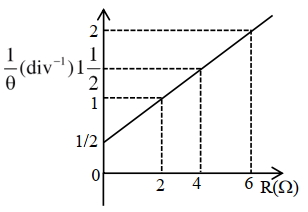
- 7In the experiment to determine the galvanometer resistance by half-deflection method, the plot of $\frac{1}{\theta}$ vs the resistance $(R)$ of the resistance box is shown in the figure. The figure of merit of the galvanometer is .............. $\times 10^{-1} \mathrm{~A} /$ division. [The source has emf 2V]View Solution
- 8View SolutionWhich of the following gives the value of magnetic field according to, Biot-Savart’s law’
- 9A straight wire carrying a current ${i_1}\,amp$ runs along the axis of a circular current ${i_2}\,amp$. Then the force of interaction between the two current carrying conductors isView Solution
- 10A galvanometer having a coil resistance of $60\,\Omega $ shows full scale deflection when a current of $1.0\, amp$ passes through it. It can be converted into an ammeter to read currents upto $5.0\, amp$ byView Solution