A spherical drop of capacitance $1\,\,\mu F$ is broken into eight drops of equal radius. Then, the capacitance of each small drop is ......$\mu F$
Easy


Download our appand get started for free
Experience the future of education. Simply download our apps or reach out to us for more information. Let's shape the future of learning together!No signup needed.*
Similar Questions
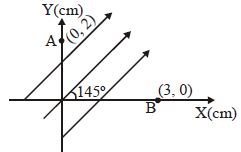
- 1A uniform electric field of $400 \,v/m$ is directed $45^o$ above the $x$ - axis. The potential difference $V_A - V_B$ is -.....$V$View Solution
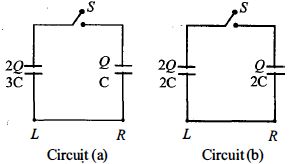
- 2Two circuits $(a)$ and $(b)$ have charged capacitors of capacitance $C, 2C$ and $3C$ with open switches. Charges on each of the capacitor are as shown in the figures. On closing the switchesView Solution
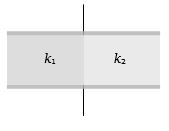
- 3A parallel plate condenser is filled with two dielectrics as shown. Area of each plate is $A\;metr{e^2}$ and the separation is $t$ $metre$. The dielectric constants are ${k_1}$ and ${k_2}$ respectively. Its capacitance in farad will beView Solution
- 4If three capacitors each of capacity $1\,\mu F$ are connected in such a way that the resultant capacity is $1.5\,\mu F$, thenView Solution
- 5Separation between the plates of a parallel plate capacitor is $d$ and the area of each plate is $A$. When a slab of material of dielectric constant $k$ and thickness $t(t < d)$ is introduced between the plates, its capacitance becomesView Solution
- 6View SolutionIf a charge is shifted from a low potential region to high potential region, the electric potential energy
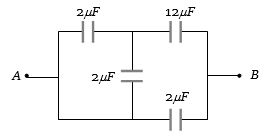
- 7Four capacitors are connected in a circuit as shown in the figure. The effective capacitance in $\mu F$ between points $A$ and $B$ will beView Solution
- 8A conducting sphere $A$ of radius $a$, with charge $Q$, is placed concentrically inside a conducting shell $B$ of radius $b$. $B$ is earthed. $C$ is the common centre of the $A$ and $B$.View Solution

- 9A battery does $200 \,J$ of work in charging a capacitor. The energy stored in the capacitor is ......... $J$View Solution
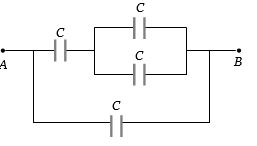
- 10Four equal capacitors, each of capacity $C$, are arranged as shown. The effective capacitance between $A$ and $B$ isView Solution