MCQ
Two thin metallic spherical shells of radii ${r}_{1}$ and ${r}_{2}$ $\left({r}_{1}<{r}_{2}\right)$ are placed with their centres coinciding. A material of thermal conductivity ${K}$ is filled in the space between the shells. The inner shell is maintained at temperature $\theta_{1}$ and the outer shell at temperature $\theta_{2}\left(\theta_{1}<\theta_{2}\right)$. The rate at which heat flows radially through the material is :-
  • $\frac{4 \pi {Kr}_{1} {r}_{2}\left(\theta_{2}-\theta_{1}\right)}{{r}_{2}-{r}_{1}}$
  • B
    $\frac{\pi{r}_{1} {r}_{2}\left(\theta_{2}-\theta_{1}\right)}{{r}_{2}-{r}_{1}}$
  • C
    $\frac{{K}\left(\theta_{2}-\theta_{1}\right)}{{r}_{2}-{r}_{1}}$
  • D
    $\frac{{K}\left(\theta_{2}-\theta_{1}\right)\left({r}_{2}-{r}_{1}\right)}{4 \pi {r}_{1} {r}_{2}}$
Answer

Correct option: A.
$\frac{4 \pi {Kr}_{1} {r}_{2}\left(\theta_{2}-\theta_{1}\right)}{{r}_{2}-{r}_{1}}$
a
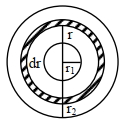
Thermal resistance of spherical sheet of thicleness $dr$ and radius $r$ is

${d} {R}=\frac{{dr}}{{K}\left(4 \pi {r}^{2}\right)}$

${R}=\int_{{r}_{1}}^{{r}_{2}} \frac{{dr}}{{K}\left(4 \pi {r}^{2}\right)}$

${R}=\frac{1}{4 \pi {K}}\left(\frac{1}{{r}_{1}}-\frac{1}{{r}_{2}}\right)=\frac{1}{4 \pi {K}}\left(\frac{{I}_{2}-{r}_{1}}{{r}_{1} {I}_{2}}\right)$

Thermal current (i) $=\frac{\theta_{2}-\theta_{1}}{R}$

${i} =\frac{4 \pi {Kr}_{1} {r}_{2}\left(\theta_{2}-\theta_{1}\right)}{{r}_{2}-{r}_{1}}$

Need a full question paper?

Generate a complete, print-ready paper with questions like this in minutes — across 16+ boards, with answer keys.

Start Generating Free

Similar questions

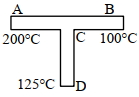
A rod $C D$ of thermal resistance $10.0\; {KW}^{-1}$ is joined at the middle of an identical rod ${AB}$ as shown in figure, The end $A, B$ and $D$ are maintained at $200^{\circ} {C}, 100^{\circ} {C}$ and $125^{\circ} {C}$ respectively. The heat current in ${CD}$ is ${P}$ watt. The value of ${P}$ is ... .
Amplitude of a mass-spring system, which is executing simple harmonic motion decreases with time. If mass $=500\, g$, Decay constant $=20 \,g / s$ then ...... $s$ time is required for the amplitude of the system to drop to half of its initial value ? $(\ln 2=0.693)$
A particle of mass $100\ g$ is thrown vertically upwards with a speed of $5\ m/s$. The work done by the force of gravity during the time the particle goes up is.....$J$
What is number of degrees of freedom of an ideal diatomic molecule at ordinary temperature?
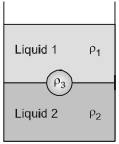
A jar is filled with two non-mixing liquids $1$ and $2$ having densities $\rho_1$ and, $\rho_2$ respectively. A solid ball, made of a material of density $\rho_3$ , is dropped in the jar. It comes to equilibrium in the position shown in the figure.Which of the following is true for $\rho_1 , \rho_2$ and $\rho_3$?
At a metro station, a girl walks up a stationary escalator in time $t_1$. If she remains stationary on the escalator, then the escalator take her up in time $t_2$​​​​​​​. The time taken by her to walk up on the moving escalator will be:
A cylinder of height 20m is completely filled with water. The velocity of efflux of water (in ms) through a small hole on the side wall of the cylinder near its bottom is:
During an adiabatic expansion of $2\, moles$ of a gas, the change in internal energy was found $-50J.$ The work done during the process is ...... $J$
Two masses $m_1$ and $m_2$ are connected by a massless spring of spring constant $k$ and unstretched length $l$. The masses are placed on a frictionless straight channel, which we consider our $X$-axis. They are initially at rest at $x=0$ and $x=l$, respectively. At $t=0$, a velocity of $v_0$ is suddenly imparted to the first particle. At a later time $t$, the centre of mass of the two masses is at
A force $F$ is applied on a square area of side $L$. If the percentage error in the measurement of $L$ is $2 \%$ and that in $F$ is $4 \%$, what is the maximum percentage error in pressure?