MCQ
Amplitude of a mass-spring system, which is executing simple harmonic motion decreases with time. If mass $=500\, g$, Decay constant $=20 \,g / s$ then ...... $s$ time is required for the amplitude of the system to drop to half of its initial value ? $(\ln 2=0.693)$
  • $34.65$
  • B
    $17.32$
  • C
    $0.034$
  • D
    $15.01$

Answer

Correct option: A.
$34.65$
a
$A = A _{0} e ^{-\gamma t }= A _{0} e ^{-\frac{ bt }{2 m }}$

$\frac{ A _{0}}{2}= A _{0} e ^{-\frac{ bt }{2 m }}$

$\frac{ bt }{2 m }=\ln 2$

$t =\frac{2 m }{ b } \ln 2=\frac{2 \times 500 \times 0.693}{20}$

$t =34.65\, second.$

Need a full question paper?

Generate a complete, print-ready paper with questions like this in minutes — across 16+ boards, with answer keys.

Start Generating Free

Similar questions

Weight of a body of mass m decreases by $1\%$ when it is raised to height $h$ above the earth’s surface. If the body is taken to a depth h in a mine, change in its weight is
In a simple pendulum experiment, the maximum percentage error in the measurement of length is $2\%$ and that in acceleration due to gravity $g$ is $4\%$. Then the maximum percentage error in determination of the time-period is
A rod of length $1.2\,m$ is clamped at the mid point and its fundamental frequency is $2\,MHz$ , then speed of wave inside the rod?
The wavelength of radiation emitted by a body depends upon
A lead ball strikes a wall and falls down, a tennis ball having the same mass and velocity strikes the wall and bounces back. Check the correct statement
If a simple pendulum is made to oscillate in water, then the time period :
In an Isothermal change, the change in pressure and volume of a gas can be represented for three different temperature; $T _3 > T _2 > T _1$ as :
If a force of $250\, N$ act on body, the momentum acquired is $125\, kg-m/s$. What is the period for which force acts on the body  ......... $\sec$
If the measurement errors in all the independent quantities are known, then it is possible to determine the error in any dependent quantity. This is done by the use of series expansion and truncating the expansion at the first power of the error. For example, consider the relation $z=x / y$. If the errors in $x, y$ and $z$ are $\Delta x, \Delta y$ and $\Delta z$, respectively, then

$\mathrm{z} \pm \Delta \mathrm{z}=\frac{\mathrm{x} \pm \Delta \mathrm{x}}{\mathrm{y} \pm \Delta \mathrm{y}}=\frac{\mathrm{x}}{\mathrm{y}}\left(1 \pm \frac{\Delta \mathrm{x}}{\mathrm{x}}\right)\left(1 \pm \frac{\Delta \mathrm{y}}{\mathrm{y}}\right)^{-1} .$

The series expansion for $\left(1 \pm \frac{\Delta y}{y}\right)^{-1}$, to first power in $\Delta y / y$, is $1 \mp(\Delta y / y)$. The relative errors in independent variables are always added. So the error in $\mathrm{z}$ will be $\Delta \mathrm{z}=\mathrm{z}\left(\frac{\Delta \mathrm{x}}{\mathrm{x}}+\frac{\Delta \mathrm{y}}{\mathrm{y}}\right)$.

The above derivation makes the assumption that $\Delta x / x<<1, \Delta \mathrm{y} / \mathrm{y} \ll<1$. Therefore, the higher powers of these quantities are neglected.

($1$) Consider the ratio $\mathrm{r}=\frac{(1-\mathrm{a})}{(1+\mathrm{a})}$ to be determined by measuring a dimensionless quantity a.

If the error in the measurement of $\mathrm{a}$ is $\Delta \mathrm{a}(\Delta \mathrm{a} / \mathrm{a} \ll<1)$, then what is the error $\Delta \mathrm{r}$ in

$(A)$ $\frac{\Delta \mathrm{a}}{(1+\mathrm{a})^2}$ $(B)$ $\frac{2 \Delta \mathrm{a}}{(1+\mathrm{a})^2}$ $(C)$ $\frac{2 \Delta \mathrm{a}}{\left(1-\mathrm{a}^2\right)}$ $(D)$ $\frac{2 \mathrm{a} \Delta \mathrm{a}}{\left(1-\mathrm{a}^2\right)}$

($2$) In an experiment the initial number of radioactive nuclei is $3000$ . It is found that $1000 \pm$ $40$ nuclei decayed in the first $1.0 \mathrm{~s}$. For $|\mathrm{x}| \ll 1$, In $(1+\mathrm{x})=\mathrm{x}$ up to first power in $x$. The error $\Delta \lambda$, in the determination of the decay constant $\lambda$, in $\mathrm{s}^{-1}$, is

$(A) 0.04$    $(B) 0.03$    $(C) 0.02$   $(D) 0.01$

Give the answer quetion ($1$) and ($2$)
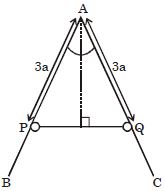
In the diagram, $BAC$ is a rigid fixed rough wire and angle $BAC$ is $60^o$. $P$ and $Q$ are two identical rings of mass $m$ connected by a light elastic string of natural length $2a$ and elastic constant $\frac{mg}{a}$. If $P$ and $Q$ are in equilibrium when $PA = AQ = 3a$ then the least coefficient of friction between the ring and the wire is $\mu$. Then value of $\mu + \sqrt 3 $ is :-