MCQ
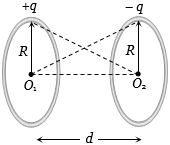
Two thin wire rings each having a radius $R$ are placed at a distance $d$ apart with their axes coinciding. The charges on the two rings are $ + q$ and $ - q$. The potential difference between the centres of the two rings is
  • A
    Zero
  • B
    $\frac{Q}{{4\pi {\varepsilon _0}}}\,\left[ {\frac{1}{R} - \frac{1}{{\sqrt {{R^2} + {d^2}} }}} \right]$
  • C
    $QR/4\pi {\varepsilon _0}{d^2}$
  • $\frac{Q}{{2\pi {\varepsilon _0}}}\left[ {\frac{1}{R} - \frac{1}{{\sqrt {{R^2} + {d^2}} }}} \right]$
Answer

Correct option: D.
$\frac{Q}{{2\pi {\varepsilon _0}}}\left[ {\frac{1}{R} - \frac{1}{{\sqrt {{R^2} + {d^2}} }}} \right]$
d
(d) Potential at the centre of rings are
${V_{{O_1}}} = \frac{{k.q}}{R} + \frac{{k( - q)}}{{\sqrt {{R^2} + {d^2}} }}$, ${V_{{O_2}}} = \frac{{k( - q)}}{R} + \frac{{kq}}{{\sqrt {{R^2} + {d^2}} }}$
$==>$ ${V_{{O_1}}} - {V_{{O_2}}} = 2kq\,\left[ {\frac{1}{R} - \frac{1}{{\sqrt {{R^2} + {d^2}} }}} \right]$$ = \frac{q}{{2\pi {\varepsilon _0}}}\left[ {\frac{1}{R} - \frac{1}{{\sqrt {{R^2} + {d^2}} }}} \right]$

Need a full question paper?

Generate a complete, print-ready paper with questions like this in minutes — across 16+ boards, with answer keys.

Start Generating Free

Similar questions

A transverse harmonic wave on a string is described by $y = 3 \sin \,(36t + 0.018x + \frac{\pi}{4})$ where $x$ and $y$ are in $cm$ and $t$ in $s$. The least distance between  two sucessive crests in the wave is .... $m$
A cart moves with a constant speed along $a$ horizontal circular path. From the cart, $a$ particle is thrown up vertically with respect to the cart
A bar magnet falls with its north pole pointing down through the axis of a copper ring. When viewed from above, the current in the ring will be
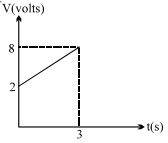
$A$ circuit element is placed in a closed box. At time $t=0$, constant current generator supplying a current of $1\, amp$, is connected across the box. Potential difference across the box varies according to graph shown in figure. The element in the box is :
If the operating potential of an $X-$ ray tube is $50 kV$, the velocity of $X-$ rays coming out of itis
Two long and parallel straight wires $A$ and $B$ carrying currents of $8.0\; A$ and $5.0\; A$ in the same direction are separated by a distance of $4.0\; cm$. Estimate the force on a $10\; cm$ section of wire $A.$
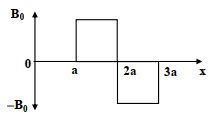
A magnetic field $\overrightarrow{\mathrm{B}}=\mathrm{B}_0 \hat{\mathrm{j}}$ exists in the region $\mathrm{a} < \mathrm{x} < 2 \mathrm{a}$ and $\vec{B}=-B_0 \hat{j}$, in the region $2 \mathrm{a} < \mathrm{x} < 3 \mathrm{a}$, where $\mathrm{B}_0$ is a positive constant. $\mathrm{A}$ positive point charge moving with a velocity $\overrightarrow{\mathrm{v}}=\mathrm{v}_0 \hat{\dot{i}}$, where $v_0$ is a positive constant, enters the magnetic field at $x=a$. The trajectory of the charge in this region can be like,
A radioactive nucleus emits a beta particle. The parent and daughter nuclei are
A ball is projected upwards from the top of tower with a velocity $50\,\,m{s^{ - 1}}$ making an angle ${30^o}$ with the horizontal. The height of tower is $ 70 \,m$. After how many seconds from the instant of throwing will the ball reach the ground  ........ $\sec$
At temperature $T,$ the $r.m.s.$ speed of helium molecules is the same as $r.m.s.$ speed of hydrogen molecules at normal temperature and pressure. The value of $T$ is  ....... $^oC$