At temperature $T,$ the $r.m.s.$ speed of helium molecules is the same as $r.m.s.$ speed of hydrogen molecules at normal temperature and pressure. The value of $T$ is ....... $^oC$
Medium


Download our appand get started for free
Experience the future of education. Simply download our apps or reach out to us for more information. Let's shape the future of learning together!No signup needed.*
Similar Questions
- 1Speed of sound in a gas is $v$ and $r.m.s.$ velocity of the gas molecules is $c.$ The ratio of $v$ to $c$ isView Solution
- 2At a given temperature, the pressure of an ideal gas of density $\rho $ is proportional toView Solution
- 3A container is divided into two equal parts $I$ and $II$ by a partition with a small hole of diameter $d$. The two partitions are filled with same ideal gas, but held at temperatures $T_{ I }=150 \,K$ and $T_{ II }=300 \,K$ by connecting to heat reservoirs. Let $\lambda_{1}$ and $\lambda_{1 I}$ be the mean free paths of the gas particles in the two parts, such that $d >> \lambda_{ I }$ and $d >> \lambda_{ II }$. Then, the $\lambda_{ I } / \lambda_{ II }$ is close toView Solution
- 4The temperature of an ideal gas at atmospheric pressure is $300\,K$ and volume $1\,m^3$. If temperature and volume become double, then pressure will beView Solution
- 5Let $\bar v , \bar v_{rms}$ and $v_p$ respectively denote the mean speed, root mean square speed and most probable speed of the molecules in an ideal monoatomic gas at absolute temperature $T$. The mass of the molecule is $m$. ThenView Solution
- 6Air is pumped into an automobile tube upto a pressure of $200\, kPa$ in the morning when the air temperature is $22°C.$ During the day, temperature rises to $42°C$ and the tube expands by $2\%.$ The pressure of the air in the tube at this temperature, will be approximately ...... $kPa$View Solution
- 7The temperature of $5$ moles of a gas which was held at constant volume was changed from ${100^o}C$ to ${120^o}C$. The change in internal energy was found to be $80$ Joules. The total heat capacity of the gas at constant volume will be equal to ...... $J/K$View Solution
- 8An electron tube was sealed off during manufacture at a pressure of $1.2 \times {10^{ - 7}}$ $mm$ of mercury at $27°C.$ Its volume is $100\, cm^3$. The number of molecules that remain in the tube isView Solution
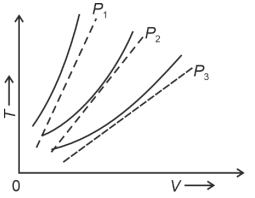
- 9The following graph represents the $T-V$ curves of an ideal gas (where $T$ is the temperature and $V$ the volume) at three pressures $P_1, P_2$ and $P_3$ compared with those of Charles's law represented as dotted lines.View Solution
Then the correct relation is:
- 10At a certain temperature, the $r.m.s.$ velocity for ${O_2}$ is $400\, m/sec.$ At the same temperature, the $r.m.s.$ velocity for ${H_2}$ molecules will be ....... $m/sec$View Solution