MCQ
Two trains travelling on the same track are approaching each other with equal speeds of $40\, m/s$. The drivers of the trains begin to decelerate simultaneously when they are just $2.0\, km$ apart. Assuming the decelerations to be uniform and equal, the value of the deceleration to barely avoid collision should be.........$m/{s^2}$
  • A
    $11.8$
  • B
    $11.0$
  • C
    $2.1$
  • $0.8$

Answer

Correct option: D.
$0.8$
d
(d) Both trains will travel a distance of $1\, km$ before to come in rest.

In this case by using ${v^2} = {u^2} + 2as$

$ \Rightarrow 0 = {(40)^2} + 2a \times 1000$

$ \Rightarrow a = - 0.8\;m/{s^2}$

Need a full question paper?

Generate a complete, print-ready paper with questions like this in minutes — across 16+ boards, with answer keys.

Start Generating Free

Similar questions

$5.74 \;g$ of a substance occuples $1.2\; cm ^{3} .$ Express its density(in $g/cm^3$) by keeping the significant figures in view.
Assertion $(A):$ The total translational kinetic energy of all the molecules of a given mass of an ideal gas is $1.5$ times the product of its pressure and volume.

Reason $(R):$ The molecules of gas collide with each other and the velocities of the molecules change due to the collision.

A closed cubical box is completely filled with water and is accelerated horizontally towards right with an acceleration α. The resultant normal force by the water on the top of the box.
A wire of length $2m$ is made from $10\ cm^3$ of copper. A force $F$ is applied so that its length increases by $2\ mm.$ Another wire of length $8m$ is made from the same volume of copper. If the force $F$ is applied to it, its length will increase by:
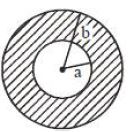
A circular disc of radius $b$ has a hole of radius $a$ at its centre (see figure). If the mass per unit area of the disc varies as $\left( {\frac{{{\sigma _0}}}{r}} \right)$, then the radius of gyration of the disc about its axis passing through the centre is
A particle is observed from two frames $S_1$ and. $S_2$. The frame $S_2$ moves with respect to $S_1$ with an acceleration $a$. Let $F_1$ and $F_2$ be the pseudo forces on the particle when seen from $S_1$ and $S_2$ respectively. Which of the following are not possible?
Match List-I with List-II and select the correct answer using the codes given below the lists 
List$-I$ List $-II$
$I-$ Joule  $A-$Henry $ \times $ Amp/sec
$ II-$ Watt   $B-$Farad  $ \times $ Volt
$ III-$ Volt $ C-$Coulomb  $ \times $ Volt
$ IV-$ Coulomb  $D-$ Oersted $ \times $ cm
  $ E-$ Amp $ \times $ Gauss
  $ F-$ $Am{p^2}$ $ \times $ Ohm
Heat is associated with:
A tuning fork of known frequency $256\,Hz$ makes $5$ beats per second with the vibrating string of a guitar. The beat frequency decreases to $2$ beats per second when the tension in the guitar string slightly increased. The frequency of the guitar string before increasing the tension was ..... $Hz$
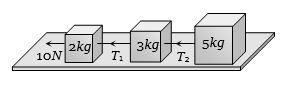
Three blocks of masses $2 \,kg, 3 \,kg$ and $5\, kg$ are connected to each other with light string and are then placed on a frictionless surface as shown in the figure. The system is pulled by a force $F = 10N,$ then tension ${T_1} = $  .......... $N$