Question
Two transparent slabs having equal thickness but different refractive indices $\mu_1$ and $\mu_2$ are pasted side by side to form a composite slab. This slab is placed just after the double slit in a Young's experiment so that the light from one slit goes through one material and the light from the other slit goes through the other material. What should be the minimum thickness of the slab so that there is a minimum at the point $P_0$ which is equidistant from the slits?
Answer

The change in path difference due to the two slabs is $(\mu_1-\mu_2) ($as in problem no. $16).$
For having a minimum at $P_0$, the path difference should change by $\frac{\lambda}{2}.$
So, $\Rightarrow\frac{\lambda}{2}=(\mu_1-\mu_2)\text{t}\Rightarrow\text{t}=\frac{\lambda}{2(\mu_1-\mu_2)}.$

Need a full question paper?

Generate a complete, print-ready paper with questions like this in minutes — across 16+ boards, with answer keys.

Start Generating Free

Similar questions

An electric field $\vec{\text{E}}=\vec{\text{i}}\text{Ax}$ exists in the space, where $A= 10Vm^{-2}.$ Take the potential at $(10m, 20m)$ to be zero. Find the potential at the origin.
Evaluate Rydberg constant by putting the values of the fundamental constants in its expression.
A capacitor of capacitance C is given a charge Q. At t = 0, it is connected to an ideal battery of emf $\epsilon$ through a resistance R. Find the charge on the capacitor at time t.
The refractive index of a material changes by 0.014 as the colour of the light changes from red to violet. A rectangular slab of height 2.00cm made of this material is placed on a newspaper. When viewed normally in yellow light, the letters appear 1.32cm below the top surface of the slab. Calculate the dispersive power of the material.
The pressure of a gas changes linearly with volume from $10\ kPa, 200\ cc$ to $50\ kPa, 50\ cc$.
  1. Calculate the work done by the gas.
  2. If no heat is supplied or extracted from the gas, what is the change in the internal energy of the gas?
Let $\vec{\text{a}}=4\vec{\text{i}}+3\vec{\text{j}}$ and $\vec{\text{b}}=3\vec{\text{i}}+4\vec{\text{j}}.$ (a) Find the magnitudes of:
  1. $\vec{\text{a}}$
  2. $\vec{\text{b}}$
  3. $\vec{\text{a}}+\vec{\text{b}}$
  4. $\vec{\text{a}}-\vec{\text{b}}$
Define electric field strength. Is it a vector or a scalar quantity?
A ray of  light passing through an equilateral triangular glass prism from air undergoes minimum deviation when angle of incidence is 3/4th of the angle of the prism. Calculate the speed of light in the prism.
You are driving a motorcycle on a horizontal road. It is moving with a uniform velocity. Is it possible to accelerate the motoreyle without putting higher petrol input rate into the engine?
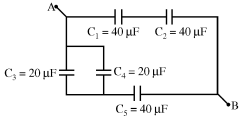
If five capacitors $C_1, C_2, C_3, C_4, C_5$ are connected in an electric circuit as shown in the figure, then calculate the equivalent capacitance of this network between point $A$ and point $B$.
Image