Question
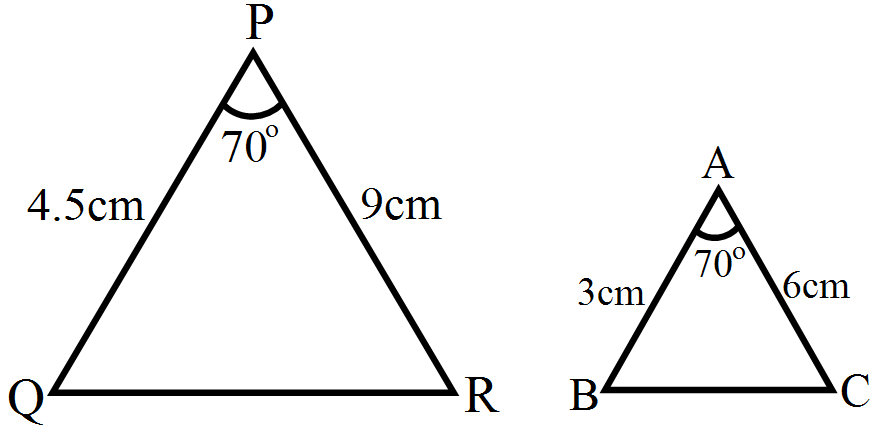
Two triangles ABC and PQR are such that AB = 3cm, AC = 6cm, $\angle\text{A}=70^\circ,\text{PR}=9\text{cm},\angle\text{P}=70^\circ$ and $\text{PQ}=4.5\text{cm}.$ show that $\triangle\text{ABC}\sim\triangle\text{PQR}$ and state the similarity criterion.
Answer


In $\triangle\text{ABC}$ and $\triangle\text{PQR},$
$\angle\text{A}=\angle\text{P}=70^\circ\ ...\ \text{(Given)}$
$\frac{\text{AB}}{\text{PQ}}=\frac{3}{4.5}=\frac{2}{3}$
$\frac{\text{AC}}{\text{PR}}=\frac{6}{9}=\frac{2}{3}$
$\Rightarrow\frac{\text{AB}}{\text{PQ}}=\frac{\text{AC}}{\text{PR}}$
so, $\triangle\text{ABC}\sim\triangle\text{PQR}$ ...(SAS criterion for similarity)

Need a full question paper?

Generate a complete, print-ready paper with questions like this in minutes — across 16+ boards, with answer keys.

Start Generating Free

Similar questions

prove the theorem : In a right angled triangle, the square of the hypotenuse is equal to the sum of the squares of remaining two sides.
Solve for x and y:
$\frac{1}{(3\text{x}+\text{y)}}+\frac{1}{(3\text{x}-\text{y)}}=\frac{3}{4},$
$\frac{1}{2(3\text{x}+\text{y)}}-\frac{1}{2(3\text{x}-\text{y)}}=\frac{-1}{8}$
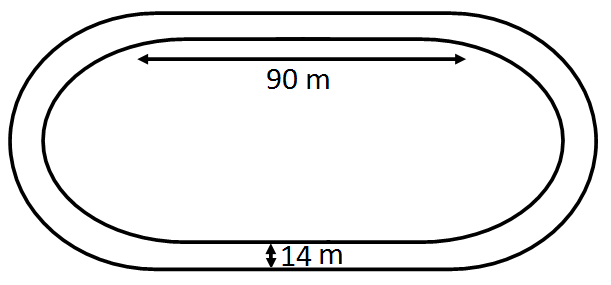
The inside perimeter of a running track (shown in the following figure) is $400\ m$. The length of each of the straight portion is $90\ m$ and the ends are semi-circles. If the track is everywhere $14\ m$ wide. find the area of the track. Also find the length of the outer running track.

If the mean of the following distribution is 27, find the value of p.
Class
0-10
10-20
20-30
30-40
40-50
Frequency
8
p
12
13
10
Find the largest number which divides $546$ and $764$, leaving remainders 6 and 8 respectively.
Following is the cumulative frequency distribution of employees in a certain office according to age.
Ageless
than
20
less
than
25
less
than
30
less
than
35
less
than
40
less
than
45
less
than
50
less
than
55
less
than
60
Cumulative
frequency
028225188105108110
Find the median age of employee.
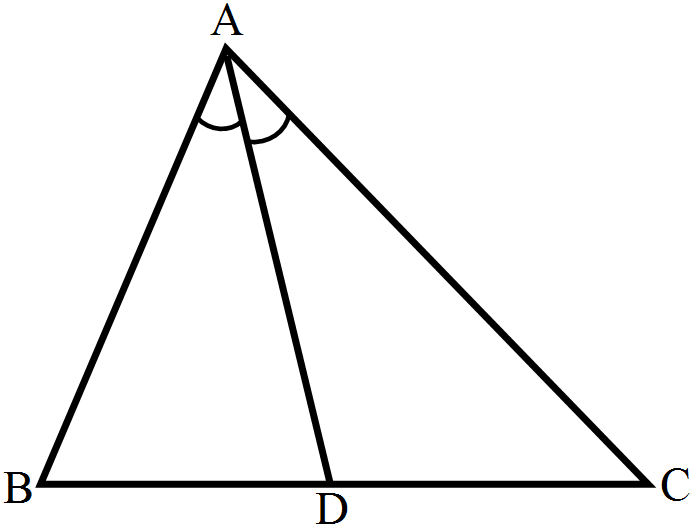
In a $\triangle\text{ABC},\text{AD}$ is the bisector of $\angle\text{A}.$
If AB = 10cm, AC = 14cm and BC = 6cm, find BD and DC.
Find the area of the triangle formed by the following lines and X axis.
$4 x-3 y+4=0$ and $4 x+3 y-20=0$
Prove that the square of any positive integer is of the form $3m$ or, $3m + 1$ but not of the from $3m + 2.$
Divide $27$ into two parts such that the sum of their reciprocals is $\frac{3}{20}.$