MCQ
Two unequal masses are tied together with a cord with a compressed spring in between.
Which one is correct?
  • A
    Both masses will have equal KE.
  • B
    Lighter block will have greater KE.
  • C
    Heavier block will have greater KE.
  • D
    None of above answers is correct.

Answer

  1. Lighter block will have greater KE.

Explanation:

Lighter block will have greater kinetic energy to lighter block will have higher velocity mass so Heavier block, hence by equation $\frac{1}{2}\text{mv}^2$, the lighter will have greater KE.

Need a full question paper?

Generate a complete, print-ready paper with questions like this in minutes — across 16+ boards, with answer keys.

Start Generating Free

Similar questions

A grinding wheel attained a velocity of $20\,rad/sec$ in $5\,sec$ starting from rest. Find the number of revolution made by the wheel
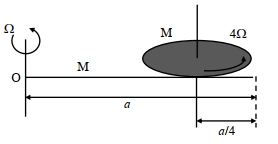
A thin rod of mass $M$ and length $a$ is free to rotate in horizontal plane about a fixed vertical axis passing through point $O$. A thin circular disc of mass $M$ and of radius $a / 4$ is pivoted on this rod with its center at a distance $a / 4$ from the free end so that it can rotate freely about its vertical axis, as shown in the figure. Assume that both the rod and the disc have uniform density and they remain horizontal during the motion. An outside stationary observer finds the rod rotating with an angular velocity $\Omega$ and the disc rotating about its vertical axis with angular velocity $4 \Omega$. The total angular momentum of the system about the point $O$ is $\left(\frac{ M a^2 \Omega}{48}\right) n$. The value of $n$ is. . . . .
An ideal gas has an initial pressure of $3$ pressure units and an initial volume of $4$ volume units. The table gives the final pressure and volume of the gas (in those same units) in four, processes. Which processes start and end on the same isotherm

$\begin{array}{|c|c|c|c|c|} \hline & A & B & C & D \\ \hline P & 5 & 4 & 12 & 6 \\ \hline V & 7 & 6 & 1 & 3 \\ \hline \end{array}$

If the temperature of a uniform rod is slightly increased by ∆t, its moment of inertia Iabout a line parallel to itself will increase by:

  1. $\text{Zero}$

  2. $\alpha\text{I}\Delta\text{t}$

  3. $2\alpha\text{I}\Delta\text{t}$

  4. $3\alpha\text{I}\Delta\text{t}$

If m is the mass, $\theta$ is temperature and 'a' is specific heat, then thermal capacity K is given by:
A body of mass $m$ is thrown upwards at an angle $\theta$ with the horizontal with velocity $v$. While rising up the velocity of the mass after $ t$ seconds will be
If CP, CV are molar specific heats of a solid and R is universal gas constant, then:
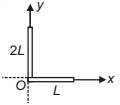
Figure shows a composite system of two uniform rods of lengths as indicated. Then the coordinates of the centre of mass of the system of rods are ...........
If a particle is fired vertically upwards from the surface of earth and reaches a height of 6400km, the initial velocity of the particle is (assume R = 6400km and g = 10ms-2)
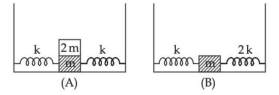
In figure $(A),$ mass ' $2 m$ ' is fixed on mass ' $m$ ' which is attached to two springs of spring constant $k$. In figure $(B),$ mass ' $m$ ' is attached to two spring of spring constant ' $k$ ' and ' $2 k$ '. If mass ' $m$ ' in $(A)$ and $(B)$ are displaced by distance ' $x$ ' horizontally and then released, then time period $T_{1}$ and $T_{2}$ corresponding to $(A)$ and $(B)$ respectively follow the relation.