A solid sphere rolls down two different inclined planes of the same heights but different angles of inclination.
- Will it reach the bottom with the same speed in each case?
- Will it take longer to roll down one plane than the other?
- If so, which one and why?
Exercise
Download our app for free and get started
- Mass of the sphere = m
Velocity of the sphere at the bottom of the plane = v
At the top of the plane, the total energy of the sphere = Potential energy = mgh
At the bottom of the plane, the sphere has both translational and rotational kinetic energies.
Hence, total energy $=\Big(\frac{1}{2}\Big)\text{mv}^2+\bigg(\frac{\frac{1}{2}}{\omega^2}\bigg)$
Using the law of conservation of energy, we can write,
$\Big(\frac{1}{2}\Big)\text{mv}^2+\bigg(\frac{\frac{1}{2}}{\omega^2}\bigg)=\text{mgh}$
For a solid sphere, the moment of inertia about its centre, $\text{I}=\Big(\frac{2}{5}\Big)\text{mr}^2$
Hence, equation (i) becomes,
$\Big(\frac{1}{2}\Big)\text{mv}^2+\Big(\frac{1}{2}\Big)\Big[\Big(\frac{2}{5}\Big)\text{mr}^2\Big]\omega^2=\text{mgh}$
$\Big(\frac{1}{2}\Big)\text{v}^2+\Big(\frac{1}{5}\Big)\text{r}^2\omega^2=\text{gh}$
But we have the relation, $\text{v}=\text{r}\omega$
$\therefore\Big(\frac{1}{2}\Big)\text{v}^2+\Big(\frac{1}{5}\Big)\text{v}^2=\text{gh}$
$\text{v}^2\Big(\frac{7}{10}\Big)=\text{gh}$
$\text{v}=\sqrt{\Big(\frac{10}{7}\Big)}\text{gh}$
Hence, the velocity of the sphere at the bottom depends only on height (h) and acceleration due to gravity (g). Both these values are constants. Therefore, the velocity at the bottom remains the same from whichever inclined plane the sphere is rolled.
- Consider two inclined planes with inclinations $\theta_1$ and $\theta_2$ related as,
The acceleration produced in the sphere when it rolls down the plane inclined at $\theta_1$ is,
$\text{g}\sin\theta_1$
The various forces acting on the sphere are shown in the following figure:
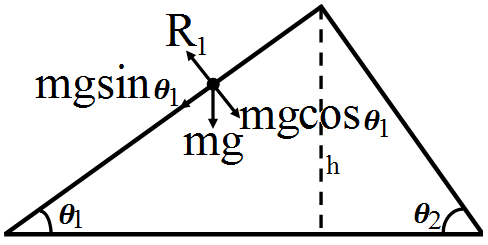
$R_1$ is the normal reaction to the sphere.
Similarly, the acceleration produced in the sphere when it rolls down the plane inclined at $\theta_2$ is,
$\text{g}\sin\theta_2$
- The various forces acting on the sphere are shown in the following figure:
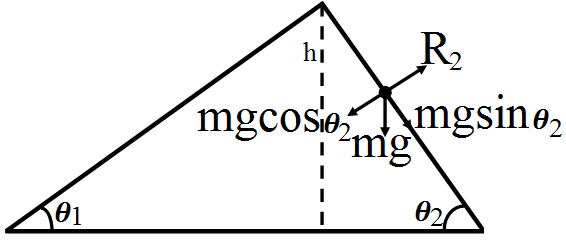
$R_2$ is the normal reaction to the sphere.
$\theta_2>\theta_1,\sin\theta_2>\sin\theta_1\ ...(\text{i})$
$\therefore\text{ a}_2>\text{a}_1\ ...(\text{ii})$
Initial velocity, u = 0
Final velocity, v = Constant
Using the first equation of motion, we can obtain the time of roll as,
$\text{v}=\text{u}+\text{at}$
$\therefore\ \text{t}\propto\Big(\frac{1}{\alpha}\Big)$
For inclination $\theta_1: \text{t}\propto\Big(\frac{1}{\alpha_1}\Big)$
For inclination $\theta_2: \text{t}\propto\Big(\frac{1}{\alpha_2}\Big)$
From above equations, we get,
$t_2< t_1$
Hence, the sphere will take a longer time to reach the bottom of the inclined plane having the smaller inclination.

Download our appand get started for free
Experience the future of education. Simply download our apps or reach out to us for more information. Let's shape the future of learning together!No signup needed.*
Similar Questions
- 1Separation of Motion of a system of particles into motion of the centre of mass and motion about the centre of mass: Show $\text{K}=\text{K}'+\frac{1}{2}\text{M}\text{V}^2$ where K' is the total kinetic energy of the system of particles, K′ is the total kinetic energy of the system when the particle velocities are taken with respect to the centre of mass and $\frac{\text{MV}^2}{2}$ is the kinetic energy of the translation of the system as a whole (i.e. of the centre of mass motion of the system). The result has been used in $\sec7.14$View Solution
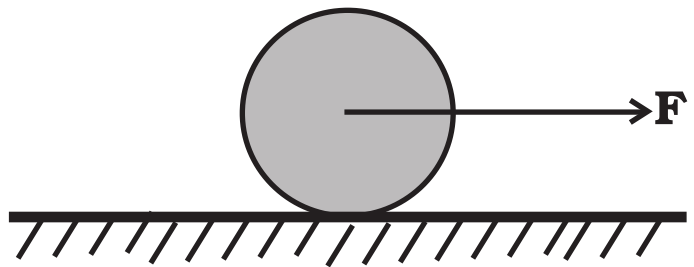
- 2A uniform disc of radius R, is resting on a table on its rim.The coefficient of friction between disc and table is $\mu.$Now the disc is pulled with a force F as shown in the figure. What is the maximum value of F for which the disc rolls without slipping?View Solution
- 3Point masses $m_1$ and $m_2$ are placed at the opposite ends of a rigid rod of length L, and negligible mass. The rod is to be set in rotation about an axis perpendicular to it. Find the position on this rod through which the axis should pass in order that the work required to set the rod in rotation with angular velocity $\omega_0$ should be minimum.View Solution
- 4View SolutionA hoop of radius 2m weighs 100kg. It rolls along a horizontal floor so that its centre of mass has a speed of 20cm/s. How much work has to be done to stop it?
- 5Separation of Motion of a system of particles into motion of the centre of mass and motion about the centre of mass: Show $\frac{\text{dL}}{\text{dt}}=\sum\text{r}'_\text{i}\times\frac{\text{dp}'}{\text{dt}}$ Further, show that $\frac{\text{dL}'}{\text{dt}}=\tau'_\text{ext}$ where $\tau'_\text{ext}$ is the sum of all external torques acting on the system about the centre of mass.View Solution
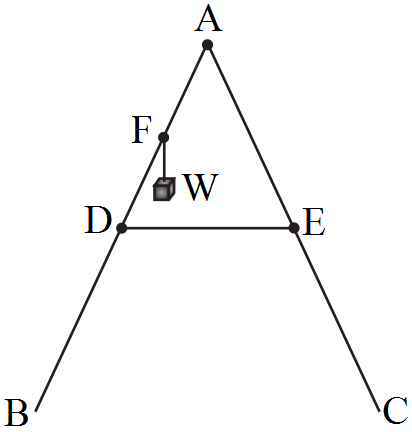
(Hint: Use the definition of centre of mass and third law of motion. Assume the internal forces between any two particles act along the line joining the particles) - 6As shown in the two sides of a step ladder BA and CA are $1.6m$ long and hinged at A. A rope DE, $0.5m$ is tied half way up. A weight $40kg$ is suspended from a point F, 1.2m from B along the ladder BA. Assuming the floor to be frictionless and neglecting the weight of the ladder, find the tension in the rope and forces exerted by the floor on the ladder. (Take $g = 9.8m/s^2$) (Hint: Consider the equilibrium of each side of the ladder separately).View Solution
- 7A mass m is allowed to roll down an inclined plane $(\theta)$ If the vertical height is h, find.View Solution
- Acceleration along the inclined plane.
- Velocity down the plane.
- 8A hollow sphere is released from the top of an inclined plane of inclination $\theta.$View Solution
- What should be the minimum coefficient of friction between the sphere and the plane to prevent sliding?
- Find the kinetic energy of the ball as it moves down a length 1 on the incline if the friction coefficient is half the value calculated in part (a).
- 93 A man stands on a rotating platform, with his arms stretched horizontally holding a 5kg weight in each hand. The angular speed of the platform is 30 revolutions per minute. The man then brings his arms close to his body with the distance of each weight from the axis changing from 90cm to 20cm. The moment of inertia of the man together with the platform may be taken to be constant and equal to $7.6kgm^2$.View Solution
- What is his new angular speed? (Neglect friction).
- Is kinetic energy conserved in the process? If not, from where does the change come about?
- 10View Solution
- Define moment of inertia. Write the parallel and perpendicular axis theorem.
- Derive an expression for moment of inertia of a disc of radius r, mass m about an axis along its diameter.