MCQ
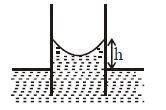
Two vertical parallel plates are partially submerged in water. The distance between plate is equal to $d$. Water rises due to surface tension $T$, the width of plate is $l$, and contact angle of water with glass is $0^o$. Find the force of attraction between the plates.
  • A
    $\frac{{{T^2}l}}{{\rho g{d^2}}}$
  • $\frac{{2{T^2}l}}{{\rho g{d^2}}}$
  • C
    $\frac{{{T^2}l}}{{2\rho g{d^2}}}$
  • D
    $\frac{{{T^2}l}}{{4\rho g{d^2}}}$

Answer

Correct option: B.
$\frac{{2{T^2}l}}{{\rho g{d^2}}}$
b
$\mathrm{F}=\left(\mathrm{P}_{0}-\mathrm{P}_{\mathrm{average}}\right) .$ $lh$

$\mathrm{F}=\left[\frac{2 T}{d}-\frac{\rho g h}{2}\right] \ell h$

$h=\frac{2 T}{\rho g d}$ so $\mathrm{F}=\frac{2 T^{2} \ell}{\rho g d^{2}}$

Need a full question paper?

Generate a complete, print-ready paper with questions like this in minutes — across 16+ boards, with answer keys.

Start Generating Free

Similar questions

An ideal gas is made to undergo the cyclic process shown in the figure below. Let $\Delta W$ depict the work done, $\Delta U$ be the change in internal energy of the gas and $Q$ be the heat added to the gas. Sign of each of these three quantities for the whole cycle will be (0 refers to no change)
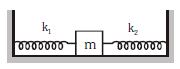
A block of mass $m$ is attached to two springs of spring constants $k_1$ and $k_2$ as shown in figure. The block is displaced by $x$ towards right and released. The velocity of the block when it is at $x/2$ will be
Which of the following quantities is the same for all ideal gases at the same temperature?
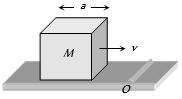
A cubical block of side $a$ is moving with velocity $v$ on a horizontal smooth plane as shown. It hits a ridge at point $O$. The angular speed of the block after it hits $O$ is 
The surface tension of a soap solution is $2 \times {10^{ - 2}}N/m.$ To blow a bubble of radius $1 \,cm,$  the work done is
The acceleration due to gravity on a planet is same as that on earth and its radius is four times that of earth. What will be the value of escape velocity on that planet if it is ${v_e}$ on earth
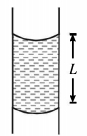
A vertical glass capillary tube of radius $r$ open at both ends contains some water (surface tension $T$ and density $\rho$ ). If $L$ be the length of the water column, then:
According to Kepler, planets move in
$N$ moles of an ideal diatomic gas are in a cylinder at temperature $T$. suppose on supplying heat to the gas, its temperature remain constant but $n$ moles get dissociated into atoms. Heat supplied to the gas is
The r.m.s. speed of gas molecules is given by