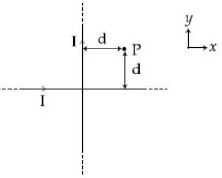
Two very long, straight and insulated wires are kept at $90^o$ angle from each other In $xy -$ plane as shown in the figure. These wires carry current of equal magnitude $I$, whose directions are shown in the figure. The net magnetic field at point $P$ will be
JEE MAIN 2019, Medium
Download our app for free and get started
Magnetic field at point $P$
$\overrightarrow{\mathrm{B}}_{\mathrm{net}}=\frac{\mu_{0} \mathrm{i}}{2 \pi \mathrm{d}}(-\hat{\mathrm{k}})+\frac{\mu_{0} \mathrm{i}}{2 \pi \mathrm{d}}(\hat{\mathrm{k}})=0$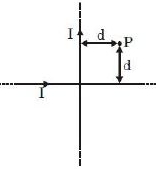

Download our appand get started for free
Experience the future of education. Simply download our apps or reach out to us for more information. Let's shape the future of learning together!No signup needed.*
Similar Questions
- 1A long straight wire of radius a carries a steady current $i$. The current is uniformly distributed across its cross section. The ratio of the magnetic field at $ a/2$ and $2a$ isView Solution
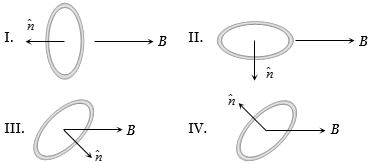
- 2A current carrying loop is placed in a uniform magnetic field in four different orientations, $I$, $II$, $III$ & $IV$ arrange them in the decreasing order of potential EnergyView Solution
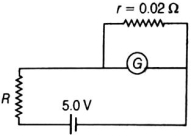
- 3In the circuit, shown the galvanometer $G$ of resistance $60\, \Omega$ is shunted by a resistance $r=0.02\, \Omega$. The current through $R$ (in $ohm$) is nearly $1\, A$. The value of resistance $R$ (in $ohm$) is nearly (in $\Omega$)View Solution
- 4An electron moves in a circular orbit with a uniform speed $v$. It produces a magnetic field $B$ at the centre of the circle. The radius of the circle is proportional toView Solution
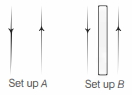
- 5In an experiment, set up $A$ consists of two parallel wires which carry currents in opposite directions as shown in the figure. $A$ second set up $B$ is identical to set up $A$, except that there is a metal plate between the wires. Let $F_A$ and $F_B$ be the magnitude of the force between the two wires in setup $A$ and setup $B$, respectively.View Solution
- 6A charged particle of mass $m$ and charge $q$ describes circular motion of radius $r$ in a uniform magnetic field of strength $B$. The frequency of revolution isView Solution
- 7The magnetic field is uniform for $y>0$ and points into the plane. The magnetic field is uniform and points out of the plane for $y<0$. A proton denoted by filled circle leaves $y=0$ in the $-y$-direction with some speed as shown below.Which of the following best denotes the trajectory of the proton?View Solution

- 8A galvanometer, whose resistance is $50\,ohm,$ has $25$ divisions in it. When a current of $4\times 10^{-4}\,A$ passes through it, its needle (pointer) deflects by one division. To use this galvanometer as a voltmeter of range $2.5\,V,$ it should be connected to a resistance of.......$ohm$View Solution
- 9A moving coil galvanometer has $150$ equal divisions. Its current sensitivity is $10$ divisions per milliampere and voltage sensitivity is $2$ divisions per millivolt. In order that each division reads $1\, volt$, the resistance in $ohms$ needed to be connected in series with the coil will beView Solution
- 10Biot-Savart, law indicates that the moving electrons (velocity $v$) produce a magnetic field $B$ such thatView Solution