Question
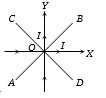
Two very thin metallic wires placed along $X$ and $Y$-axis carry equal currents as shown here. $AB$ and $CD$ are lines at $45^\circ $ with the axes with origin of axes at $O$. The magnetic field will be zero on the line
Answer

(a) Every point on line $AB$ will be equidistant from $X $ and $Y$-axis. So magnetic field at every point on line $AB$ due to wire $1$ along $X$-axis is equal in magnitude but opposite in direction to the magnetic field due to wire along $Y$-axis. Hence ${B_{net}}$ on $AB = 0$

Need a full question paper?

Generate a complete, print-ready paper with questions like this in minutes — across 16+ boards, with answer keys.
Start Generating Free

Similar questions

The tension in a piano wire is $10N$. What should be the tension in the wire to produce a note of double the frequency .... $N$
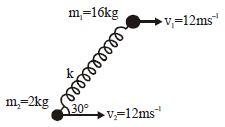
Two particles with mass $m_1$ = $16\ kg$ and $m_2$ = $2\ kg$ slide as unit with a common velocity of $12\ ms^{-1}$ on a level frictionless surface. Between them is a compressed massless spring with spring constant $k$ = $100\ Nm^{-1}$ . The spring, originally compressed by $25\ cm$ , is suddenly released, sending the two masses, which are connected to the spring, flying apart from each other. The orientation of the spring w.r.t. the initial velocity is shown in diagram. What is the relative velocity of separation in $ms^{-1}$ , after the particles lose contact? ................$m/s$
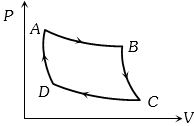
Carnot cycle (reversible) of a gas represented by a Pressure-Volume curve is shown in the diagramConsider the following statements

$I.$ Area $ABCD =$ Work done on the gas

$II.$ Area $ABCD =$ Net heat absorbed

$III.$ Change in the internal energy in cycle $= 0$

Which of these are correct
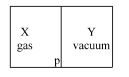
A closed container is fully insulated from outside. One half of it is filled with an ideal gas $X$ separated by a plate Pfrom the other half $Y$ which contains a vacuum as shown in figure. When $P$ is removed, $X$ moves into $Y$. Which of the following statements is correct?
Find the gravitational field at a distance of $2000\, km$ from centre of earth. (in $m / s ^{2}$)

(Given $\left.R_{\text {earth }}=6400 km , r =2000 km , M _{\text {earth }}=6 \times 10^{24} kg \right)$
A mass of $1\, kg$ is hanging from a spring of spring constant $1\, N/m$. If Saroj pulls the mass down by $2\,m$. The work done by Saroj is......$J$
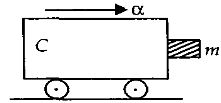
A block of mass $m$ is in contact with the cart $C$ as shown in the figure. The coefficient of static friction between the block and the cart is $\mu .$ The acceleration $\alpha$ of the cart that will prevent the block from falling satisfies
If the breaking force for a given wire is $F$, then the breaking force of two wires of same magnitude will be
A body starts falling freely from height $\mathrm{H}$ hits an inclined plane in its path at height $\mathrm{h}$. As a result of this perfectly elastic impact, the direction of the velocity of the body becomes horizontal. The value of $\frac{\mathrm{H}}{\mathrm{h}}$ for which the body will take the maximum time to reach the ground is______.
An astronomical telescope has an angular magnification of magnitude $5$ for distant objects. The separation between the objective and the eye piece is $36 cm $ and the final image is formed at infinity. The focal length $f_o$ of the objective and the focal length $f_e$ of the eye piece are