Two walls of thicknesses $d_1$ and $d_2$ and thermal conductivities $k_1$ and $k_2$ are in contact. In the steady state, if the temperatures at the outer surfaces are ${T_1}$ and ${T_2}$, the temperature at the common wall is
Medium
Download our app for free and get started
(a) In series both walls have same rate of heat flow. Therefore
$\frac{{dQ}}{{dt}} = \frac{{{K_1}A({T_1} - \theta )}}{{{d_1}}} = \frac{{{K_2}A(\theta - {T_2})}}{{{d_2}}}$
$\frac{{dQ}}{{dt}} = \frac{{{K_1}A({T_1} - \theta )}}{{{d_1}}} = \frac{{{K_2}A(\theta - {T_2})}}{{{d_2}}}$
$ \Rightarrow {K_1}{d_2}({T_1} - \theta ) = {K_2}{d_1}(\theta - {T_2})$
$ \Rightarrow \theta = \frac{{{K_1}{d_2}{T_1} + {K_2}{d_1}{T_2}}}{{{K_1}{d_2} + {K_2}{d_1}}}$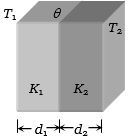

Download our appand get started for free
Experience the future of education. Simply download our apps or reach out to us for more information. Let's shape the future of learning together!No signup needed.*
Similar Questions
- 1Certain quantity of water cools from $70^o C$ to $60^o C$ in the first $5$ minutes and to $54^o C$ in the next $5$ minutes. The temperature of the surroundings is ..... $^oC$View Solution
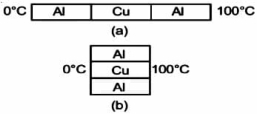
- 2The three rods shown in figure have identical dimensions. Heat flows from the hot end at a rate of $40 \,W$ in the arrangement $(a)$. Find the rates of heat flow when the rods are joined as in arrangement $(b)$ is ......... $W$ (Assume $K_al=200 \,W / m ^{\circ} C$ and $\left.K_{c u}=400 \,W / m ^{\circ} C \right)$View Solution
- 3The ends $\mathrm{Q}$ and $\mathrm{R}$ of two thin wires, $\mathrm{PQ}$ and $RS$, are soldered (joined) togetker. Initially each of the wires has a length of $1 \mathrm{~m}$ at $10^{\circ} \mathrm{C}$. Now the end $\mathrm{P}$ is maintained at $10^{\circ} \mathrm{C}$, while the end $\mathrm{S}$ is heated and maintained at $400^{\circ} \mathrm{C}$. The system is thermally insulated from its surroundings. If the thermal conductivity of wire $\mathrm{PQ}$ is twice that of the wire $RS$ and the coefficient of linear thermal expansion of $P Q$ is $1.2 \times 10^{-5} \mathrm{~K}^{-1}$, the change in length of the wire $\mathrm{PQ}$ isView Solution
- 4View SolutionThe amount of radiation emitted by a perfectly black body is proportional to
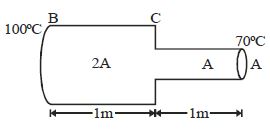
- 5A metal rod of length $2\, m$ has cross-sectional areas $2A$ and $A$ as shown in the following figure. The two ends are maintained at temperatures $100\,^oC$ and $70\,^oC$. The temperature of middle point $C$ is ........ $^oC$View Solution
- 6View SolutionMud houses are cooler in summer and warmer in winter because
- 7In a certain planetary system, it is observed that one of the celestial bodies having a surface temperature of $200 \;K$, emits radiation of maximum intensity near the wavelength $12\; \mu m$. The surface temperature (in $K$) of a nearby star which emits light of maximum intensity at a wavelength $\lambda= 4800\;\mathring A$ isView Solution
- 8The ratio of energy of emitted radiation of a black body at ${27^o}C$ and ${927^o}C$ isView Solution
- 9Four identical rods of same material are joined end to end to form a square. If the temperature difference between the ends of a diagonal is ${100^o}C$, then the temperature difference between the ends of other diagonal will be ........ $^oC$View Solution
- 10Consider a compound slab consisting of two different materials having equal thickness and thermal conductivities $ K$ and $2K$ respectively. The equivalent thermal conductivity of the slab isView Solution