MCQ
Two water pipes of diameters $2\ cm$ and $4\ cm$ are connected with the main supply line. The velocity of flow of water in the pipe of $2\ cm$ diameter is:
  • $4$ times that in the other pipe.
  • B
    $\frac14$ times that in the other pipe.
  • C
    $2$ times that in the other pipe.
  • D
    $\frac12$ times that in the other pipe.
Answer

Correct option: A.
$4$ times that in the other pipe.
From equation of continuity, $av =$ constant
$d_A = 2\ cm$ and $d_B = 4\ cm$
$\therefore\text{r}_\text{A}=1\text{cm}$ and $\text{r}_\text{B}=2\text{cm}$
$\therefore\frac{\text{v}_\text{A}}{\text{v}_\text{B}}=\frac{\text{a}_\text{B}}{\text{a}_\text{A}}=\frac{\pi(\text{r}_\text{B})^2}{\pi\text{(r}_\text{A})^2}$
$=\Big(\frac21\Big)^2$
$\Rightarrow\text{v}-\text{A}=4\text{v}_\text{B}$

Need a full question paper?

Generate a complete, print-ready paper with questions like this in minutes — across 16+ boards, with answer keys.

Start Generating Free

Similar questions

At which temperature the speed of sound in hydrogen will be same as that of speed of sound in oxygen at $100\,^oC$  ..... $^oC$
You have two containers of equal volume. One is full of helium gas. The other holds an equal mass of nitrogen gas. Both gases have the same pressure. How does the temperature of the helium compare to the temperature of the nitrogen ?
Equation of motion of a body is $\frac{d v}{d t}=-4 v+8$, where $v$ is the velocity in $m / s$ and $t$ is the time in second. Initial velocity of the particle was zero. Then,
Energy is being emitted from the surface of a black body at $127\,^oC$ temperature at the rate of $1.0 \times {10^6}\,J/s - {m^2}$. Temperature of the black body at which the rate of energy emission is $16.0 \times {10^6}\,J/s - {m^2}$ will be   ......... $^oC$
Abarometer tube, containing mercury, is lowered in a vessel containing mercury until only $50\,\, cm$ of the tube is above the level of mercury in the vessel. If the atmospheric pressure is $75 \,\,cm$ of mercury, what is the pressure at the top of the tube?
Two planets revolve round the sun with frequencies ${N_1}$ and ${N_2}$ revolutions per year. If their average orbital radii be ${R_1}$ and ${R_2}$ respectively, then ${R_1}/{R_2}$ is equal to
A cart is moving horizontally along a straight line with a constant speed of $30\,m / s$. A projectile is to be fired from the moving cart in such a way that it will retum to the cart (at the same point on cart) after the cart has moved $80\,m$. At what velocity (relative to the cart) must be projectile be fired? (Take $=10\,m / s ^2$ )
Two bodies are thrown simultaneously from a tower with same initial velocity ${v_0}:$ one vertically upwards, the other vertically downwards. The distance between the two bodies after time $t$ is
Solar constant $(S)$ depends upon the temperature of the Sun $(T)$ as ........
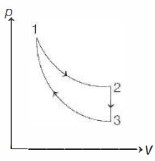
The three processes in a thermodynamic cycle shown in the figure are : Process $1 \rightarrow 2$ is isothermal; Process $2 \rightarrow 3$ is isochoric (volume remains constant); Process $3 \rightarrow 1$ is adiabatic. The total work done by the ideal gas in this cycle is $10 \,J$. The internal energy decreases by $20 \,J$ in the isochoric process. The work done by the gas in the adiabatic process is $-20 \,J$. The heat added to the system in the isothermal process is .............. $J$