MCQ
Two waves having equations
$ x_1=a \sin \left(\omega t+\phi_1\right), x_2=a \sin \left(\omega t+\phi_2\right)$
If in the resultant wave the frequency and amplitude remain equal to those of superimposing waves. Then phase difference between them is
  • A
    $\frac{\pi}{6}$
  • $\frac{2 \pi}{3}$
  • C
    $\frac{\pi}{4}$
  • D
    $\frac{\pi}{3}$

Answer

Correct option: B.
$\frac{2 \pi}{3}$
(b) Superposition of waves does not alter the frequency of resultant wave and resultant amplitude
$\Rightarrow a^2=a^2+a^2+2a^2\cos\phi=2a^2(1+\cos\phi)$
$\Rightarrow \cos \phi=-1 / 2=\cos 2 \pi / 3 $
$\therefore \phi=2 \pi / 3$

Need a full question paper?

Generate a complete, print-ready paper with questions like this in minutes — across 16+ boards, with answer keys.

Start Generating Free

Similar questions

When a current passes through a wire whose different parts are maintained at different temperatures, evolution or absorption of heat all along the length of wire is known as
The condition for a uniform spherical mass $m$ of radius $r$ to be a black hole is [ $G=$ gravitational constant and $g=$ acceleration due to gravity]
An electron (charge $=1.6 \times 10^{-19} \mathrm{C}$ ) is accelerated through a potential of $100,000 \mathrm{~V}$. The energy acquired by the electron is
A string vibrates according to the equation $y=5 \sin \left(\frac{2 \pi x}{3}\right) \cos 20\  \pi t$, where $x$ and $y$ are in $\mathrm{cm}$ and $t$ in sec. The distance between two adjacent nodes is
Two forces of magnitude $F$ have a resultant of the same magnitude $F$. The angle between the two forces is
In an adiabatic process, the state of a gas is changed from $P_1, V_1, T_1$, to $P_2, V_2, T_2$. Which of the following relation is correct
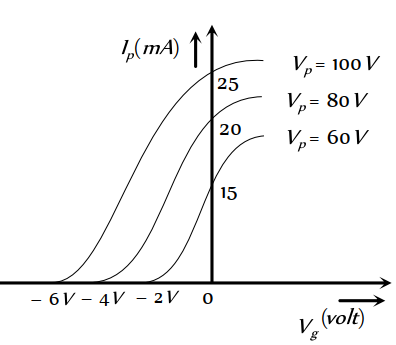
The variation of anode current in a triode corresponding to a change in grid potential at three different values of the plate potential is shown in the diagram. The mutual conductance of the triode isImage
Two waves are represented by the equations $y_1=a \sin \omega t$ and $y_2=a \cos \omega t$. The first wave
If $m$ is mass of electron, $v$ its velocity, $r$ the radius of stationary circular orbit around a nucleus with charge $Z e$, then from Bohr's first postulate, the kinetic energy $K=\frac{1}{2} m v^2$ of the electron in C.G.S. system is equal to
The temperature of a hypothetical gas increases to $\sqrt{2}$ times when compressed adiabatically to half the volume. Its equation can be written as