Question
Two waves, travelling in the same direction through the same region, have equal frequencies, wavelengths and amplitudes. If the amplitude of each wave is 4mm and the phase difference between the waves is 90°, what is the resultant amplitude?
Answer

Phase difference $\phi=\frac{\pi}{2}$ f and $\lambda$ are same. So, $\omega$ is same.$\text{y}_1=\text{r}\sin\text{wt},\ \text{y}_2=\text{r}\sin\big(\text{wt}+\frac{\pi}{2}\big)$
From the principle of superposition$\text{y}=\text{y}_1+\text{y}_2$
$=\text{r}\sin\text{wt}+\text{r}\sin\big(\text{wt}+\frac{\pi}{2}\big)$
$=\text{r}\Big[\sin\text{wt}+\text{r}\sin\big(\text{wt}+\frac{\pi}{2}\big)\Big]$
$=\text{r}\Bigg[2\sin\bigg\{\frac{\big(\text{wt}+\text{wt}+\frac{\pi}{2}\big)}{2}\bigg\}\cos\bigg\{\frac{\big(\text{wt}-\text{wt}-\frac{\pi}{2}\big)}{2}\bigg\}\Bigg]$
$\Rightarrow\text{y}=2\text{r}\sin\Big(\text{wt}+\frac{\pi}{4}\Big)\cos\Big(\frac{-\pi}{4}\Big)$
Resultant amplitude $=\sqrt{2}\text{r}=4\sqrt{2}\text{mm}$ (because r = 4mm)

Need a full question paper?

Generate a complete, print-ready paper with questions like this in minutes — across 16+ boards, with answer keys.

Start Generating Free

Similar questions

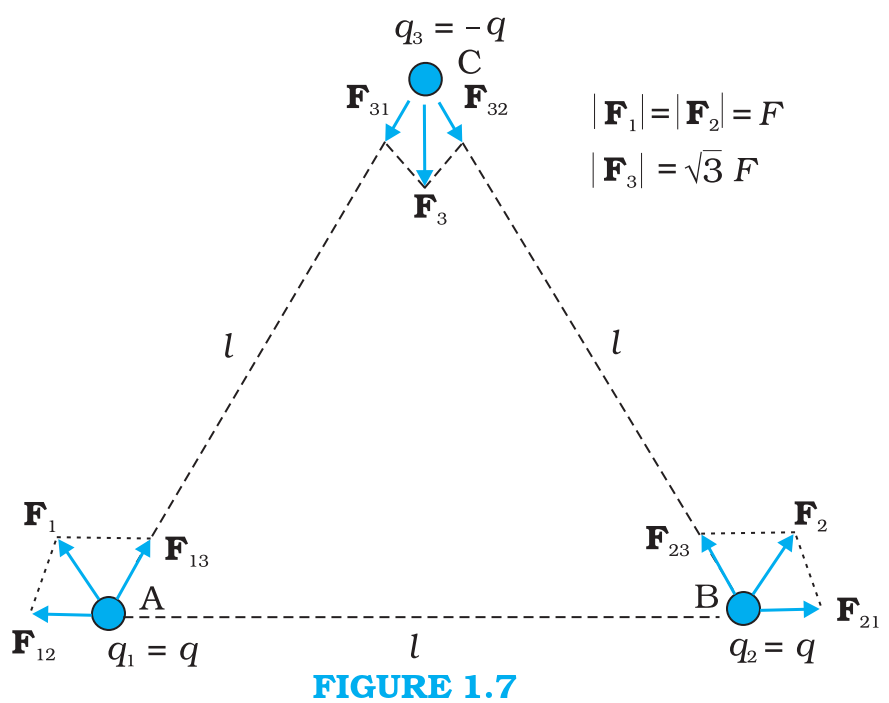
Consider the charges q, q, and –q placed at the vertices of an equilateral triangle, as shown in Fig. 1.7. What is the force on each charge?
Image
A circular coil of 16 turns and radius 10 cm carrying a current of 0.75 A rests with its plane normal to an external field of magnitude $5.0 \times 10^{–2} T$. The coil is free to turn about an axis in its plane perpendicular to the field direction. When the coil is turned slightly and released, it oscillates about its stable equilibrium with a frequency of $2.0\ s^{–1}$. What is the moment of inertia of the coil about its axis of rotation?
Two prisms of identical geometrical shape are combined with their refracting angles oppositely directed. The materials of the prisms have refractive indices 1.52 and 1.62 for violet light. A violet ray is deviated by 1.0° when passes symmetrically through this combination. What is the angle of the prisms?
Suppose while sitting in a parked car, you notice a jogger approaching towards you in the side view mirror of $R=2 m$. If the jogger is running at a speed of $5 m s ^{-1}$, how fast the image of the jogger appear to move when the jogger is (a) $39 m$, (b) $29 m$, (c) $19 m$, and (d) $9 m$ away.
A cylindrical metallic wire is stretched to increase its length by 10%. Calculate the percentage increase in its resistance.
You have learnt that plane and convex mirrors produce virtual images of objects. Can they produce real images under some circumstances? Explain.
$i.$ Define the term self$-$inductance and write its $S.I.$ unit.
$ii.$ Obtain the expression for the mutual inductance of two long co$-$axial solenoids $S_1$ and $S_2$ wound one over the other, each of length $L$ and radii $r_1$ and $r_2$ and $n_1$ and $n_2$ number of turns per unit length, when a current $I$ is set up in the outer solenoid $S _2$.
A source of ac voltage $ v= v_0 \sin\omega t$, is connected across a pure inductor of inductance L. Derive the expressions for the instantaneous current in the circuit. Show that average power dissipated in the circuit is zero.
Answer the following question:
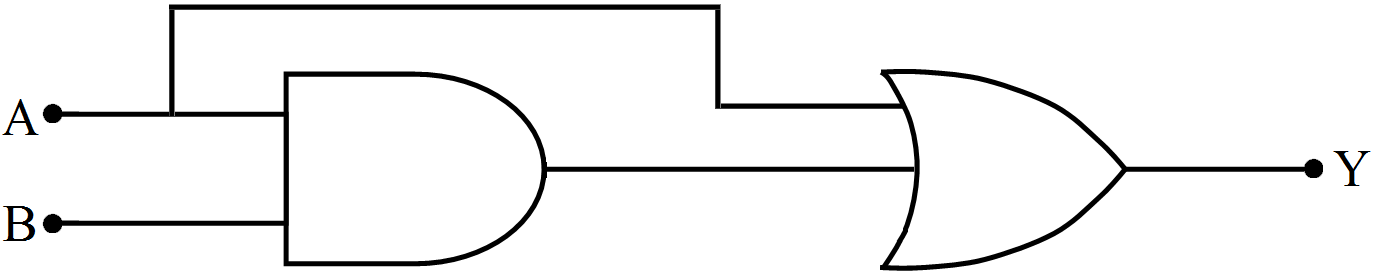
  1. Write the truth table of the following gate.
  1. What will be the values of inputs A and B for the Boolean expression.
$\text{A}\bar{+}\text{B}).(\text{A}\bar{.}\text{B})=1$
Find the radius and energy of a $He^+$ ion in the states (a) n = 1, (b) n = 4 and (c) n = 10.