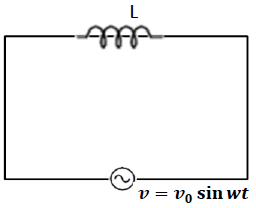
A source of ac voltage $ v= v_0 \sin\omega t$, is connected across a pure inductor of inductance L. Derive the expressions for the instantaneous current in the circuit. Show that average power dissipated in the circuit is zero.
CBSE FOREIGN - SET 3 2017
Download our app for free and get started
Given $V=V_0\sin\omega t$
$V=L\frac{di}{dt}\Rightarrow di=\frac{V}{L}dt$
$\therefore\text{ }di=\frac{\text{V}_0}{L}\sin\omega t\text{ }dt$
Integrating $i=-\frac{\text{V}_0}{wL}\cos\omega t$
$\therefore\text{}i=-\frac{\text{V}_0}{wL}\sin(\pi/2-\omega t)=I_0\sin(\pi/2-\omega t)$
where $I_0=\frac{V_0}{wL}$
Average power
$P_{av}=\int\limits_{0}^{T}vi\text{ }dt$
$=\frac{-V_0^2}{wL}\int_0^T\sin\omega t\cos\omega t\text{ }dt$
$=\frac{-V_0^2}{wL}\int_0^T\sin(2\text{ }\omega t)\text{ }dt$
= 0
$V=L\frac{di}{dt}\Rightarrow di=\frac{V}{L}dt$
$\therefore\text{ }di=\frac{\text{V}_0}{L}\sin\omega t\text{ }dt$
Integrating $i=-\frac{\text{V}_0}{wL}\cos\omega t$
$\therefore\text{}i=-\frac{\text{V}_0}{wL}\sin(\pi/2-\omega t)=I_0\sin(\pi/2-\omega t)$
where $I_0=\frac{V_0}{wL}$
Average power
$P_{av}=\int\limits_{0}^{T}vi\text{ }dt$
$=\frac{-V_0^2}{wL}\int_0^T\sin\omega t\cos\omega t\text{ }dt$
$=\frac{-V_0^2}{wL}\int_0^T\sin(2\text{ }\omega t)\text{ }dt$
= 0

Download our appand get started for free
Experience the future of education. Simply download our apps or reach out to us for more information. Let's shape the future of learning together!No signup needed.*
Similar Questions
- 1View SolutionState Biot – Savart law. Deduce the expression for the magnetic field at a point on the axis of a current carrying circular loop of radius ‘R’, distant ‘x’ from the centre. Hence write the magnetic field at the centre of a loop.
- 2An inductor 200mH, a capacitor $100\mu\text{F}$ and a resistor $10\Omega$ are connected in series to an a.c. source of 100V, having variable frequency.View Solution
- At what frequency of the applied voltage will the power factor of the circuit be 1?
- What will be the current amplitude at this frequency?
- Calculate the Q-factor of the circuit.
- 3View SolutionA transformer has 50 turns in the primary and 100 in the secondary. If the primary is connected to a 220V DC supply, what will be the voltage across the secondary?
- 4View SolutionBoth alternating current and direct current are measured in amperes. But how is the ampere defined for an alternating current?
- 5View Solution
- Name two important processes that occur during the formation of a pn junction.
- Draw the circuit diagram of a full wave rectifier along with the input and output waveforms. Briefly, explain how the output voltage/current is unidirectional.
- 6A resistance R and a capacitor C are connected in series to a source $\text{V}=\text{V}_0\sin\omega\text{t}.$View Solution
Find:- The peak value of the voltage across the (i) resistance and (ii) capacitor.
- The phase difference between the applied voltage and current. Which of them is ahead?
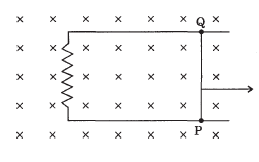
- 7View SolutionA 0’5 m long metal rod PQ completes the circuit as shown in the figure. The area of the circuit is perpendicular to the magnetic field of flux density 0-15 T. If the resistance of the total circuit is 3Ω, calcularod in the direction as indicated with a constant speed ofte the force needed to move the rod in the direction as indicated with a constant speed of 2ms−1.
- 8In the given circuit, the value of resistance effect of the coil L is exactly equal to the resistance R. Bulbs $B_1$ and $B_2$ are exactly identical. Answer the following questions based on above information:View Solution
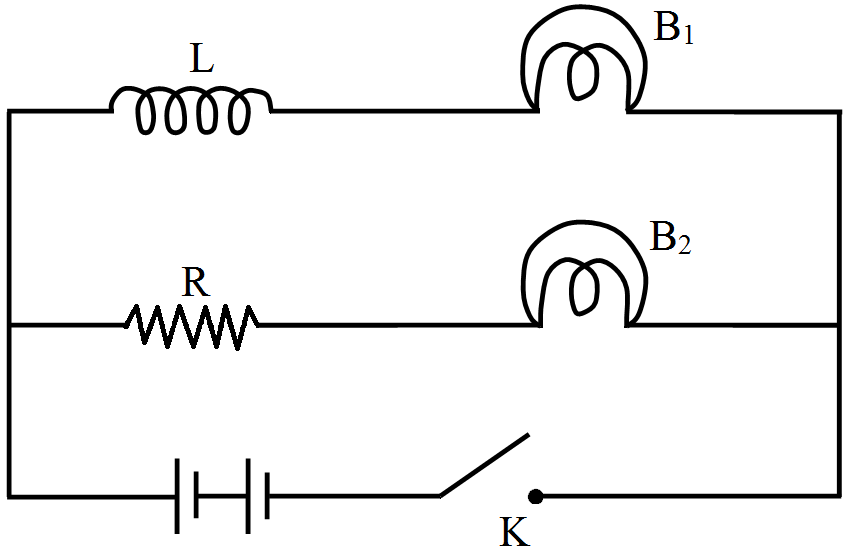
- Which one of the two bulbs lights up earlier, when key K is closed and why?
- What will be the comparative brightness of the two bulbs after sometime if the key K is kept closed and why?
- 9When an inductor L and a resistor R in series are connected across a 12 V, 50 Hz supply, a current of 0.5 A flows in the circuit. The current differs in phase from applied voltage by $\pi/3$ radian. Calculate the value of R.View Solution
- 10View SolutionIn what way is Gauss’s law in magnetism different from that used in electrostatics? Explain briefly. The Earth’s magnetic field at the Equator is approximately 0.4 G. Estimate the Earth’s magnetic dipole moment. Given: Radius of the Earth = 6400 km.