Two waves ${y_1} = {A_1}\sin (\omega t - {\beta _1})$, ${y_2} = {A_2}\sin (\omega t - {\beta _2})$ Superimpose to form a resultant wave whose amplitude is
Easy
Download our app for free and get started
(a) Phase difference between the two waves is
$\phi = (\omega t - {\beta _2}) - (\omega t - {\beta _1}) = ({\beta _1} - {\beta _2})$
Resultant amplitude $A = \sqrt {A_1^2 + A_2^2 + 2{A_1}{A_2}\cos ({\beta _1} - {\beta _2})} $

Download our appand get started for free
Experience the future of education. Simply download our apps or reach out to us for more information. Let's shape the future of learning together!No signup needed.*
Similar Questions
- 1Three coherent waves of equal frequencies having amplitude $10 \,\, \mu m$, $4\,\,\mu m$ and $7 \,\,\mu m$ respectively, arrive at a given point with successive phase difference of $\pi /2$. The amplitude of the resulting wave in $mm$ is given byView Solution
- 2View SolutionFor a wave propagating in a medium, identity the property that is independent of the others
- 3A policeman on duty detects a drop of $10 \%$ in the pitch of the hom of motion of car as it crosses him. If the velocity of sound is $330 \,m / s$. Calculate the speed of the car ........... $m / s$View Solution
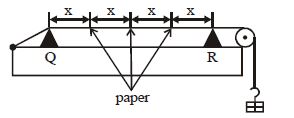
- 4The given diagram shows three light pieces of paper placed on a wire that is stretched over two supports, $Q$ and $R$ , a distance $4x$ apart. When the wire is made to vibrate at a particular frequency, all the pieces of paper, except the middle one, fall off the wire. Which of the following could be the wavelength of the vibration?View Solution
- 5View SolutionTransverse waves can propagate in
- 6View SolutionWhich of the following statements is false
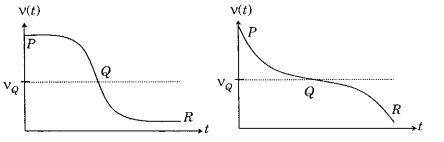
- 7Two loudspeakers $M$ and $N$ are located $20 \mathrm{~m}$ apart and emit sound at frequencies $118 \mathrm{~Hz}$ and $121 \mathrm{~Hz}$, respectively. $A$ car is initially at a point $P, 1800 \mathrm{~m}$ away from the midpoint $Q$ of the line $M N$ and moves towards $Q$ constantly at $60 \mathrm{~km} / \mathrm{hr}$ along the perpendicular bisector of $M N$. It crosses $Q$ and eventually reaches a point $R, 1800(m$ away from $Q$. Let $v(t)$ represent the beat frequency measured by a person sitting in tlie car at time $t$. Let $v_P, v_Q$ and $v_R$ be the beat frequencies measured at locations $P . Q$ and $R$, respectively. The speed of sound in air is $330 \mathrm{~m} \mathrm{~s}^{-1}$. Which of the following statement($s$) is(are) true regarding the sound heard by the person?View Solution
($A$) $v_P+v_R=2 v_Q$
($B$) The rate of change in beat frequency is maximum when the car passes through $Q$
($C$) The plot below represents schematically the variation of beat frequency with time
(image)
($D$) The plot below represents schematically the variation of beat frequency with time
(image)
- 8View SolutionIn Melde’s experiment in the transverse mode, the frequency of the tuning fork and the frequency of the waves in the strings are in the ratio
- 9If the phase difference between the two wave is 2$\pi $ during superposition, then the resultant amplitude isView Solution
- 10The fundamental frequency of vibration of a string stretched between two rigid support is $50\,Hz$. The mass of the string is $18\,g$ and its linear mass density is $20\,g / m$. The speed of the transverse waves so produced in the string is $..........\,ms ^{-1}$View Solution