Two whistles $A$ and $B$ each have a frequency of $500\,\,Hz$. $A$ is stationary and $B$ is moving towards the right (away from $A$) at a speed of $50\,\, m/s$. An observer is between the two whistles moving towards the right with a speed of $25\,\, m/s.$ The velocity of sound in air is $350 \,\,m/s$. Assume there is no wind. Then which of the following statements are true:
Diffcult
Download our app for free and get started
Applying Doppler's effect equation,
$n_{A}^{\prime}=\frac{350-25}{350} 500=464.28 \mathrm{Hz}$
$n_{B}^{\prime}=\frac{350+25}{350+50} 500=468.75 H z$
options $"B"$ and $"C"$ are correct.

Download our appand get started for free
Experience the future of education. Simply download our apps or reach out to us for more information. Let's shape the future of learning together!No signup needed.*
Similar Questions
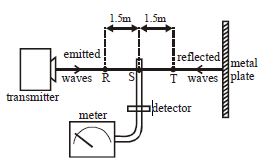
- 1The given diagram shows a detector placed between a transmitter of sound waves and a metal plate. At three adjacent points, $ R, S$ and $T$ , the meter shows zero intensity. Which of the following is the frequency of the emitted wave ... $Hz$ ? (Take the velocity of sound as $ = 300\ m/s$ )View Solution
- 2Two tuning forks $A\,\, \& \,\,B$ produce notes of frequencies $256 Hz \,\,\& \,\,262 Hz$ respectively. An unknown note sounded at the same time as $A$ produces beats . When the same note is sounded with $B$, beat frequency is twice as large . The unknown frequency could be ... $Hz$View Solution
- 3In a plane progressive wave given by $y = 25\cos (2\pi t - \pi x)$, the amplitude and frequency are respectivelyView Solution
- 4View SolutionA perfectly elastic uniform string is suspended vertically with its upper end fixed to the ceiling and the lower end loaded with the weight. If a transverse wave is imparted to the lower end of the string, the pulse will
- 5Following statements are given for a stationary waveView Solution
$(a)$ Every particle has a fixed amplitude which is different from the amplitude of its nearest particle.
$(b)$ All the particles cross their mean position at the same time.
$(c)$ All the particles are oscillating with same amplitude.
$(d)$ There is no net transfer of energy across any plane.
$(e)$ There are some particles which are always at rest.
Which of the following is correct
- 6A wire of density $9 \times 10^3 \,kg/m^3$ is stretched between two clamps one meter apart and is subjected to an extension of $4.9 \times 10^{-4} \,m$. What will be the lowest frequency of the transverse vibrations in the wire ... $Hz$ $[Y = 9 \times 10^{10} \,N/m^2]$ ?View Solution
- 7View SolutionWhat is the phase difference between the displacement wave and pressure wave in sound wave?
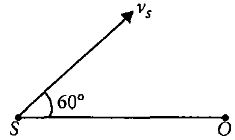
- 8A source of sound $S$ emitting waves of frequency $100\,\, Hz$ and an observer $O$ are ocated at some distance from each other. The source is moving with a speed of $19 .4\,\, m s^{-1}$ at an angle of $60^o $ with the source observer line as shown in the figure. The observer is at rest. The apparent frequency observed by the observer .... $Hz$ (velocity of sound in air $330 \,\, m s^{-1}$), isView Solution
- 9View SolutionWhen we hear a sound, we can identify its source from
- 10Two waves are propagating along a taut string that coincides with the $x-$axis. The first wave has the wave function $y_1 = A cos [k(x - vt)]$ and the second has the wave function $y = A cos [k(x + vt) + \phi ]$.View Solution