Two whistles $A$ and $B$ produces notes of frequencies $660 Hz$ and $596 Hz$ respectively. There is a listener at the mid-point of the line joining them. Now the whistle $B$ and the listener start moving with speed $30 m/s$ away from the whistle $A.$ If speed of sound be $330 m/s,$ how many beats will be heard by the listener
Medium


Download our appand get started for free
Experience the future of education. Simply download our apps or reach out to us for more information. Let's shape the future of learning together!No signup needed.*
Similar Questions
- 1In an organ pipe whose one end is at $x = 0$, the pressure is expressed by $p = {p_0}\cos \frac{{3\pi x}}{2} \,\,sin\,\, 300\pi t$ where $x$ is in meter and $t$ in $sec$. The organ pipe can beView Solution
- 2A closed organ pipe has a frequency $'n'$. If its length is doubled and radius is halved, its frequency nearly becomes-View Solution
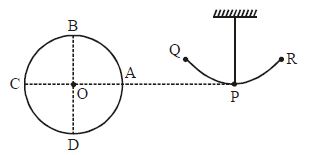
- 3A sound source is moving on a circular path of radius $R$ with constant angular speed $\omega $ in anticlockwise direction and emits a frequency $n$ . An observer performs simple harmonic along the path $QPR$ with time period $T = \frac {2\pi }{\omega }$ as shown in the figure. If at $t = 0$ source is at $A$ and observer is at $Q$ and assume $OP$ is very large as compare to radius $R$ and $QP$ , thenView Solution
- 4Two strings $X$ and $Y$ of a sitar produce a beat frequency $4 Hz$. When the tension of the string $Y$ is slightly increased the beat frequency is found to be $2 Hz.$ If the frequency of $X$ is $300 Hz,$ then the original frequency of $Y$ was .... $Hz$View Solution
- 5A source of sound of frequency $256 Hz$ is moving rapidly towards a wall with a velocity of $5m/s$. The speed of sound is $330 m/s.$ If the observer is between the wall and the source, then beats per second heard will be .... $Hz$View Solution
- 6A plane wave $y=A\,\, sin\,\, \omega \left( {t - \frac{x}{v}} \right)$ undergo a normal incidence on a plane boundary separating medium $M_1$ and $M_2$ and splits into a reflected and transmitted wave having speeds $v_1$ and $v_2$ thenView Solution
- 7A $1 cm$ long string vibrates with fundamental frequency of $256\, Hz$. If the length is reduced to $\frac{1}{4}cm$ keeping the tension unaltered, the new fundamental frequency will beView Solution
- 8A transverse wave is passing through a string shown in figure. Mass density of the string is $1 \ kg/m^3$ and cross section area of string is $0.01\ m^2.$ Equation of wave in string is $y = 2sin (20t - 10x).$ The hanging mass is (in $kg$):-View Solution
- 9Standing waves are generated on a sonometer string loaded with a cylindrical body. If the cylinder is completely immersed in water, the length of the loops changes by a factor of $2.2$ . The specific gravity of the material of the cylinder isView Solution
- 10An open and a closed organ pipe are of same length. The ratio of the frequency of the $n^{th}$ mode of vibration of the two pipes isView Solution