Two wires $A$ and $B $ of same length and of the same material have the respective radii ${r_1}$ and ${r_2}$. Their one end is fixed with a rigid support, and at the other end equal twisting couple is applied. Then the ratio of the angle of twist at the end of $A$ and the angle of twist at the end of $B $ will be
AIIMS 1980, Diffcult


Download our appand get started for free
Experience the future of education. Simply download our apps or reach out to us for more information. Let's shape the future of learning together!No signup needed.*
Similar Questions
- 1View SolutionWhich is correct relation
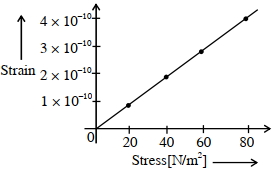
- 2The elastic behaviour of material for linear streass and linear strain, is shown in the figure. The energy density for a linear strain of $5 \times 10^{-4}$ is $\dots \; kJ / m ^{3}$. Assume that material is elastic upto the linear strain of $5 \times 10^{-4}$.View Solution
- 3A wire of length $L$ and radius $r$ is clamped at one end. If its other end is pulled by a force $F$, its length increases by $l$. If the radius of the wire and the applied force both are reduced to half of their original values keeping original length constant, the increase in length will become.View Solution
- 4View SolutionThe elastic limit for a gas
- 5A load $W$ produces an extension of $1mm$ in a thread of radius $r.$ Now if the load is made $4W$ and radius is made $2r$ all other things remaining same, the extension will become..... $mm$View Solution
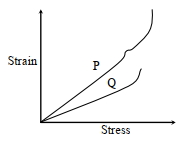
- 6In plotting stress versus strain curves for two materials $P$ and $Q$, a student by mistake puts strain on the $y$-axis and stress on the $x$-axis as shown in the figure. Then the correct statement$(s)$ is(are)View Solution
$(A)$ $P$ has more tensile strength than $Q$
$(B)$ $P$ is more ductile than $Q$
$(C)$ $P$ is more brittle than $Q$
$(D)$ The Young's modulus of $P$ is more than that of $Q$
- 7Force constant of a spring $(K)$ is synonymous toView Solution
- 8View SolutionThe Poisson's ratio cannot have the value
- 9The Poisson's ratio of a material is $0.5$. If a force is applied to a wire of this material, there is a decrease in the cross-sectional area by $4 \%$. The percentage increase in the length is ........ $\%$View Solution
- 10The temperature of a wire of length $1$ metre and area of cross-section $1\,c{m^2}$ is increased from $0°C$ to $100°C$. If the rod is not allowed to increase in length, the force required will be $(\alpha = {10^{ - 5}}/^\circ C$ and $Y = {10^{11}}\,N/{m^2})$View Solution