MCQ
Two wires $A$ and $B$ of same length, same area of cross-section having the same Young's modulus are heated to the same range of temperature. If the coefficient of linear expansion of $A$ is $3/2$ times of that of wire $B$. The ratio of the forces produced in two wires will be
  • A
    $2/3$
  • B
    $9/4$
  • C
    $4/9$
  • $3/2$

Answer

Correct option: D.
$3/2$
d
(d) $F = YA\alpha \Delta \theta $

If $Y, A$ and $\Delta \theta$ are constant then $\frac{{{F_A}}}{{{F_B}}} = \frac{{{\alpha _A}}}{{{\alpha _B}}} = \frac{3}{2}$

Need a full question paper?

Generate a complete, print-ready paper with questions like this in minutes — across 16+ boards, with answer keys.

Start Generating Free

Similar questions

The focal length of a convex mirror is $20\, cm$ its radius of curvature will be.....$cm$
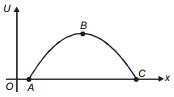
The variation of potential energy $U$ of a body moving along $x$-axis varies with its position $(x)$ as shown in figure  The body is in equilibrium state at
For adiabatic process, wrong statement is
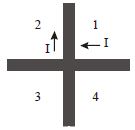
Identical currents flow in two perpendicular wires, as shown in the figure. The wires are very close but do not touch. The magnetic field can be zero:
An $LC$ resonant circuit contains a $400 pF$ capacitor and a $100\mu H$ inductor. It is set into oscillation coupled to an antenna. The wavelength of the radiated electromagnetic waves is
Which figure shows the correct variation of applied potential difference $(V)$ with photoelectric current $(I)$ at two different intensities of light ( $\mathrm{I}_1<$ $\mathrm{I}_2$ ) of same wavelengths :
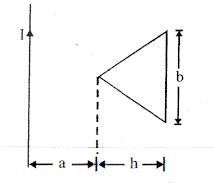
A very long straight conductor and isosceles triangular conductor lie in a plane and are separated from each other as shown in the figure. If $a = 10\ cm , b = 20\ cm$ and $h = 10\ cm$ , find the coefficient of mutuaI induction
A uniform rope of mass $1.0\, kg$ is connected with a box of mass $2.0\, kg$, which is  placed on a smooth horizontal surface. The free end of the rope is pulled horizontally by a  force $6\, N$. Find the tension at the midpoint of the rope. ............ $N$
At an angle of $30^{\circ}$ to the magnetic meridian, the apparent dip is $45^{\circ} .$ Find the true dip :
A moving coil galvanometer of resistance $100 \,\Omega$ is used as an ammeter using a resistance $0.1 \,\Omega$. The maximum deflection current in the galvanometer is $100\,\mu A$. Find the minimum current in the circuit so that the ammeter shows maximum deflection ............... $mA$