In a series combination of copper and steel wires of same length and same diameter, a force is applied at one of their ends while the other end is kept fixed. The combined length is increased by $2\, cm$. The wires will have ..........
Easy


Download our appand get started for free
Experience the future of education. Simply download our apps or reach out to us for more information. Let's shape the future of learning together!No signup needed.*
Similar Questions
- 1Two persons pull a wire towards themselves. Each person exerts a force of $200 \mathrm{~N}$ on the wire. Young's modulus of the material of wire is $1 \times 10^{11} \mathrm{~N} \mathrm{~m}^{-2}$. Original length of the wire is $2 \mathrm{~m}$ and the area of cross section is $2 \mathrm{~cm}^2$. The wire will extend in length by . . . . . . . .$\mu \mathrm{m}$.View Solution
- 2The length of an iron wire is $L$ and area of cross-section is $A$. The increase in length is $l$ on applying the force $F$ on its two ends. Which of the statement is correctView Solution
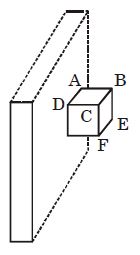
- 3A steel rod is projecting out of rigid wall. The shearing strength of steel is $345 \,\,MN/m^2.$ The dimensions $AB = 5\,\, cm,\,BC = BE = 2\,\, cm.$ The maximum load that can be put on the face $ABCD$ is .......... $kg$ (neglect bending of the rod) $(g = 10\,\, m/s^2)$View Solution
- 4View SolutionThe units of Young ‘s modulus of elasticity are
- 5View SolutionThe adiabatic elasticity of a gas is equal to
- 6View SolutionCorrect pair is ..........
- 7Two wires $A$ and $B$ are of same materials. Their lengths are in the ratio $1 : 2$ and diameters are in the ratio $2 : 1$ when stretched by force ${F_A}$ and ${F_B}$ respectively they get equal increase in their lengths. Then the ratio ${F_A}/{F_B}$ should beView Solution
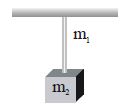
- 8One end of a uniform rod of mass $m_1$ and crosssectional area $A$ is hung from a ceiling. The other end of the bar is supporting mass $m_2$. The stress at the midpoint isView Solution
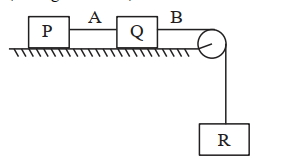
- 9Each of three blocks $P$, $Q$ and $R$ shown in figure has a mass of $3 \mathrm{~kg}$. Each of the wire $A$ and $B$ has cross-sectional area $0.005 \mathrm{~cm}^2$ and Young's modulus $2 \times 10^{11} \mathrm{~N} \mathrm{~m}^{-2}$. Neglecting friction, the longitudinal strain on wire $B$ is____________ $\times 10^{-4}$. $\left(\right.$ Take $\mathrm{g}=10 \mathrm{~m} / \mathrm{s}^2$ )View Solution
- 10The depth below the surface of sea to which a rubber ball be taken so as to decrease its volume by $0.02 \%$ is______ $\mathrm{m}$.View Solution
(Take density of sea water $=10^3 \mathrm{kgm}^{-3}$, Bulk modulus of rubber $=9 \times 10^8 \mathrm{Nm}^{-2}$, and $\mathrm{g}=10 \mathrm{~ms}^{-2}$ )