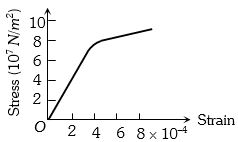
Two wires $‘A’$ and $‘B’$ of the same material have radii in the ratio $2 : 1$ and lengths in the ratio $4 : 1$. The ratio of the normal forces required to produce the same change in the lengths of these two wires is
Medium


Download our appand get started for free
Experience the future of education. Simply download our apps or reach out to us for more information. Let's shape the future of learning together!No signup needed.*
Similar Questions
- 1The force required to stretch a wire of crosssection $1 cm ^{2}$ to double its length will be ........ $ \times 10^{7}\,N$View Solution
(Given Yong's modulus of the wire $=2 \times 10^{11}\,N / m ^{2}$ )
- 2A steel wire of diameter $2\ mm$ has a breaking strength of $4 \times 10^5 N$.the breaking force $......... \times 10^5 N$ of similar steel wire of diameter $1.5\ mm ?$View Solution
- 3The bulk modulus of a spherical object is '$B$'. If it is subjected to uniform pressure '$P$', the fractional decrease in radius isView Solution
- 4Two exactly similar wires of steel and copper are stretched by equal forces. If the total elongation is $2 \ cm$, then how much is the elongation in steel and copper wire respectively? Given, $Y_{\text {steel }}=20 \times 10^{11} dyne / \ cm ^2, Y_{\text {copper }}=12 \times 10^{11} dyne / \ cm ^2$View Solution
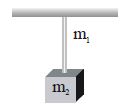
- 5One end of a uniform rod of mass $m_1$ and crosssectional area $A$ is hung from a ceiling. The other end of the bar is supporting mass $m_2$. The stress at the midpoint isView Solution
- 6View SolutionThe reason for the change in shape of a regular body is
- 7An increases in pressure required to decreases the $200\,\,litres$ volume of a liquid by $0.004\%$ in container is ........... $kPa$. (Bulk modulus of the liquid $= 2100\,\,MPa$ )View Solution
- 8A wire of length $5 m$ is twisted through $30^{\circ}$ at free end. If the radius of wire is $1\ mm$, the shearing strain in the wire is $..........$View Solution
- 9A uniform metallic wire is elongated by $0.04\, m$ when subjected to a linear force $F$. The elongation, if its length and diameter is doubled and subjected to the same force will be ..... $cm .$View Solution
- 10Which one of the following is the Young’s modulus $($in $N/m^2)$ for the wire having the stress-strain curve shown in the figureView Solution